

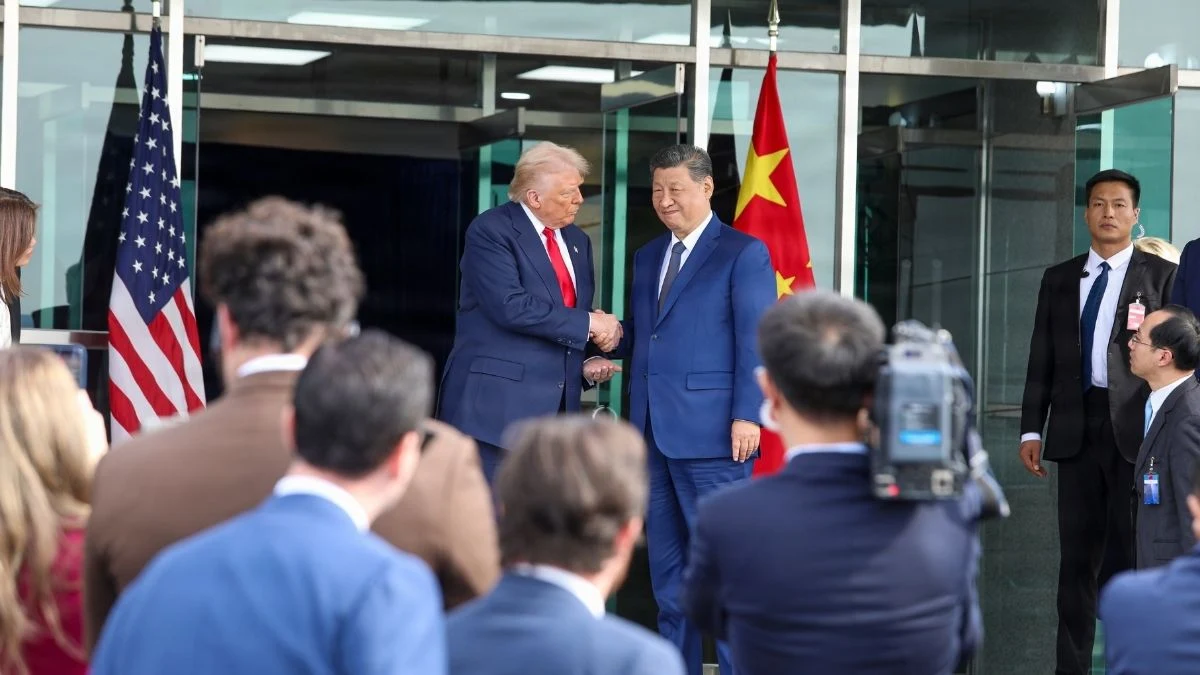
When the leaders of the world’s two largest economies conclude a highly anticipated, two-day summit in Beijing, the global financial terminals expect structural breakthroughs. Instead, the recent meetings delivered a calculated paradox. The United States and China successfully finalized a massive commodity agreement, guaranteeing $17 billion annually in US agricultural purchases by Beijing for 2026, 2027, and 2028. Yet, behind the handshake over soybeans and wheat, the summit completely collapsed regarding every systemic issue that actually dictates the future of global power: the ongoing war in Iran, advanced technology access, and military posture.
This is not a diplomatic failure; it is the deliberate execution of a new global economic model. We are witnessing the formal initiation of “managed decoupling.” The era of comprehensive, borderless economic integration is officially dead, replaced by a stratified system where basic commodities are permitted to flow, but advanced technology and national security assets are aggressively hoarded.
The Strategy Behind the Agricultural Floor
To decode this summit, we must separate the political theater from the macroeconomic reality. The $17 billion agricultural commitment is a transactional necessity for both sides. For the United States, this multi-year purchase agreement stabilizes a critical domestic constituency in the Midwest, securing agricultural revenue streams amidst a highly volatile global inflation cycle. For Beijing, securing a steady, massive influx of foundational food supplies ensures internal stability and predictable caloric baselines for its vast population.
They are mutually constructing an economic floor. By cordoning off basic agricultural trade from their systemic geopolitical disputes, both superpowers are ensuring that their populations do not suffer immediate, catastrophic shortages. However, this foundational trade is merely a shock absorber. It is designed to keep the lowest levels of the economy functioning smoothly while a fierce, unrestricted conflict rages in the higher tiers of technological development.
The High-Tech Fortress and the 15th Five-Year Plan
While agricultural vessels will continue to cross the Pacific, the flow of advanced silicon, intellectual property, and critical minerals is being systematically blocked. The Beijing Summit failed to produce any alignment on technology access because neither side is willing to compromise on their digital future.
Former US trade officials accurately characterize this new dynamic not as integration, but as an exercise in “managing the relationship” to keep a rocky situation as stable as possible. The expectations have permanently shifted toward containment. This strategy is explicitly visible in China’s concurrent Global Trade and Investment Promotion Summit, which focused intensely on the upcoming 15th Five-Year Plan (2026-2030). Beijing is heavily prioritizing the development of “new quality productive forces.”
The objective of this state-directed plan is absolute. China is demonstrating an uncompromising commitment to achieving total self-reliance in advanced manufacturing and technology. By developing fully independent supply chains for microchips, artificial intelligence, and quantum computing, Beijing aims to completely insulate its national infrastructure against future Western economic coercion or sanctions.
The Reality of a Bifurcated Global Economy
This deliberate stratification of trade forces the rest of the world into a complex logistical and diplomatic maze. The global economy is actively being bifurcated into safe domains and restricted domains.
- Commodity Fluidity: Rudimentary goods, raw agricultural products, and non-strategic materials will continue to move across borders with relative ease, maintaining a baseline of global commerce.
- Technological Isolation: Advanced hardware, proprietary software architectures, and critical energy components will be heavily restricted, treated as weapons of national defense rather than commercial products.
- The Squeeze on Emerging Markets: Developing nations will face intense pressure to choose technological ecosystems. A country may buy grain from both sides, but they will be forced to commit to either a Western or a Chinese telecommunications and AI infrastructure, effectively splitting global digital networks.
The Beijing Summit did not solve the friction between Washington and Beijing; it simply organized it. By agreeing on agriculture and walking away from technology and military disputes, the two superpowers have clearly drawn the battle lines for the next decade. The global supply chain is no longer a unified web; it is a fractured landscape where food is traded freely, but the technology that shapes the future is locked behind impenetrable national walls.