

It was just past 1 a.m. when the first sounds arrived — the low, droning hum that Kyiv residents have learned to recognize before they even reach for their phones. But something was different this time. The drones were not the story. They were the setup.
In the early hours of May 24, 2026, Russian forces launched one of the most extensive aerial assaults of the war: 90 missiles and over 600 Shahed-type attack drones directed at Ukrainian territory. Buried inside that barrage was a weapon that had only been used twice before in this conflict — the Oreshnik intermediate-range ballistic missile, a system capable of carrying multiple nuclear or conventional warheads, traveling at speeds that make interception by current air defense systems nearly impossible. At least four civilians were killed. Injury figures vary across sources, ranging from 60 to over 100 wounded.
The question that matters most is not just what happened — but why it was done this way.
The Setup: How 600 Cheap Drones Paved the Way
Long before the Oreshnik left its launcher, the battlefield was being carefully prepared.
The 600 Shahed drones that preceded the main strike were not expected to cause catastrophic damage on their own. Their job was different: to force Ukraine’s air defense systems to work at full capacity for hours, burning through interceptor stockpiles that take months to replenish. A single Patriot missile costs roughly $4 million. A Shahed costs a few thousand. The math is deliberately punishing.
Ukraine’s Air Force confirmed that the majority of drones and missiles were intercepted. But interception was never the point of the drones. Exhaustion was.
Only once the defensive layer had been stretched thin did the high-value strike follow. This sequencing — swarm first, precision second — reflects hard lessons absorbed from years of attritional warfare. It is a doctrine built not on brute force alone, but on the deliberate exploitation of an opponent’s resource constraints.
What Is the Oreshnik, Exactly?
A brief technical note matters here.
Oreshnik means “hazel shrub” in Russian — an unremarkable name for a weapon that has drawn significant attention from Western defense analysts. It is a road-mobile intermediate-range ballistic missile, assessed by the United States as capable of carrying multiple independently targetable warheads, either conventional or nuclear. It travels at approximately Mach 10, making it extraordinarily difficult to intercept with systems currently available to Ukraine.
This was the third confirmed combat use of the Oreshnik. It was first fired at Dnipro in November 2024, then at Ukraine’s Lviv region in January 2026. The May 24 strike marked the first time the weapon was directed at the Kyiv region.
In each instance, the missile carried conventional warheads. That detail, however, does little to diminish the strategic significance of repeatedly deploying a nuclear-capable system in an active war zone.
Two Versions of the Same Night
What was actually targeted remains a matter of sharp dispute.
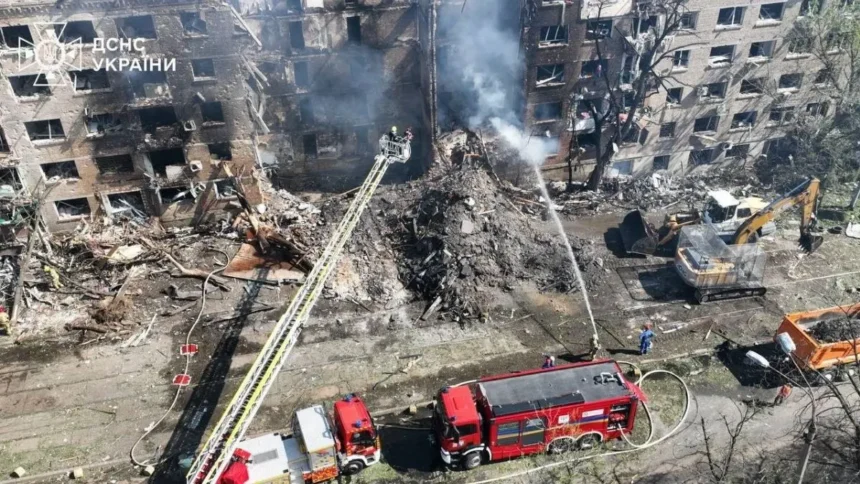
Ukrainian officials and independent observers documented damage to civilian markets, water supply infrastructure, schools, and the immediate surroundings of key government buildings including the Ministry of Foreign Affairs and the Cabinet of Ministers. President Zelensky stated that approximately 30 residential buildings in Kyiv alone were damaged or destroyed — making it, by the assessment of Kyiv City Military Administration head Tymur Tkachenko, the most extensive single-night assault on the capital since the full-scale war began.
Russia’s Defense Ministry offered a different account. In official statements, the ministry said the strike was directed at Ukraine’s military-industrial complex, intelligence facilities, and command centers, specifically naming the Main Intelligence Directorate as a target. It also confirmed the use of the Oreshnik alongside Iskander, Kinzhal, and Zircon missiles, and stated that no civilian infrastructure was intentionally targeted.
Both narratives sit alongside photographs of burning residential buildings and shattered school windows. Reconciling them requires considerably more than official press releases from either side.
The Second Missile: An Unverified Claim Worth Watching
Here the picture becomes genuinely murky — and the distinction matters.
Ukrainian open-source intelligence channel eRadar reported that two Oreshnik missiles were fired during the attack. According to their analysis, the first launch appeared to strike near Avdiivka or Yasynuvata in Russian-controlled Donetsk — suggesting either a technical malfunction or a serious navigational failure. The second missile, they argued, was the one that struck Bila Tserkva in the Kyiv region, the launch Ukraine’s Air Force officially confirmed.
Ukraine’s Air Force, however, confirmed only one Oreshnik impact on Ukrainian-controlled territory. Spokesperson Yuriy Ihnat stated there was no information about a second launch.
This claim remains at the level of unverified OSINT analysis. Video geolocation work by the Ukrainian research community Kiberboroshno offered supporting detail — identifying camera positions and directions of observed warhead separation — but independent confirmation of where a second missile may have landed, or whether it impacted Russian positions, has not been established.
It is worth watching. It is not yet established fact.
The Wider Signal
Strip away the tactical details and a harder question emerges.
A nuclear-capable ballistic missile has now been used three times in an active European conflict, each time with conventional warheads. EU foreign policy chief Kaja Kallas called the deployment “reckless nuclear brinkmanship.” French President Macron condemned what he described as deliberate targeting of civilian infrastructure. German Chancellor Friedrich Merz added his condemnation.
The significance is not purely military. Deterrence theory rests on a series of shared assumptions about what weapons mean when they appear on a battlefield. When a system associated with nuclear capability is repeatedly normalized in conventional use, those assumptions shift — not all at once, but incrementally. Each use changes what the next use means.
That recalibration does not happen in isolation. The May 24 strike takes place against a backdrop of simultaneous pressures in the Gulf, East Asia, and sub-Saharan Africa — each crisis feeding into global energy markets, supply chains, and diplomatic bandwidth. What happens in one theater no longer stays there.
The Oreshnik did not simply hit Bila Tserkva. It landed in the middle of a much larger argument about what the rules of international security still mean — and who, if anyone, is enforcing them.