

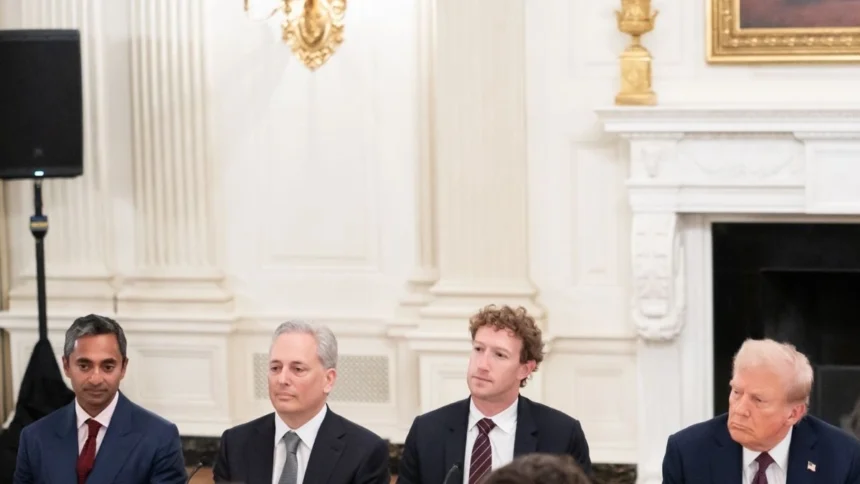
On a quiet Thursday morning, executives from the largest technology companies in the world were already on their way to Washington. The White House had sent invitations. The Oval Office ceremony was scheduled. Then, hours before the planned signing, everything stopped.
President Donald Trump declined to sign a long-anticipated executive order on artificial intelligence safety — an order that would have established the first federal-level voluntary review mechanism for frontier AI models before their public release. Companies would have been able to submit advanced systems to government agencies for security evaluation up to 90 days ahead of deployment. No licensing regime. No mandatory holds. Voluntary — and apparently still too much.
“I didn’t like certain aspects of it,” Trump told reporters.
We’re leading China, we’re leading everybody, and I don’t want to do anything that’s going to get in the way of that.
Donald J. Trump
Geopolitical competition as a rationale
The administration’s stated logic is straightforward: in a high-stakes technology race with China, even a voluntary 90-day review window carries strategic cost. Every week of delay, the argument goes, is a week in which a competitor could close the gap.
It is a coherent position — and one that has genuine supporters within the national security community. The problem, according to critics, is that it frames regulatory caution as inherently equivalent to strategic weakness, a conflation that may not hold under scrutiny. Beijing, for its part, issued new rules in April 2026 requiring AI companies to establish internal ethics review committees, and has listed AI legislation for review in the National People’s Congress for three consecutive years. China is writing rules. Washington cancelled a ceremony.
The calls that changed everything
What the official geopolitical narrative does not fully account for is what took place in the hours before Trump’s decision.
According to reporting from Semafor, Politico, the Washington Post, and multiple other outlets, Elon Musk, Mark Zuckerberg, and former White House AI and crypto coordinator David Sacks each contacted the president directly — between Wednesday night and Thursday morning — to advocate against the order. Sacks, who had formally stepped down from his advisory role in March, called Trump the morning of the planned ceremony.
The intervention appears to have worked in part by appealing to the “accelerationist” faction within the administration, including officials at the National Economic Council and staffers in the Vice President’s office, according to sources cited by Semafor.
Worth noting: OpenAI, whose chief lobbyist had been broadly supportive of government collaboration on AI safety, backed the executive order. The industry was not unanimous. The companies that pushed back most forcefully — xAI and Meta — are both developing frontier models in direct competition with the firms that favored oversight.
The regulatory gap left behind
The shelved order would have been the first U.S. federal mechanism of its kind. The UK and EU have both built voluntary evaluation pipelines for advanced AI systems through their respective AI safety institutes. The U.S. now has neither a mandatory nor a voluntary federal framework in place.
This matters most not in the abstract, but in concrete terms. The order was under consideration in part because of the recent debut of Anthropic’s Mythos model, which possesses what researchers describe as unprecedented autonomous cyber capabilities — capabilities that Anthropic itself voluntarily restricted out of concern over potential misuse against critical infrastructure. The administration was aware of this context when it declined to sign.
Experts in AI governance and biosecurity have pointed to several categories of risk that a pre-deployment review process was intended to address: AI-facilitated synthesis of biological agents, exploitation of large-scale cybersecurity vulnerabilities, and the deployment of autonomous disinformation systems. Whether a voluntary review window would have meaningfully mitigated any of these risks is a legitimate question. It is one that U.S. policy will now leave largely unanswered.
What this moment may signal
The clearest takeaway from Thursday’s episode may be structural rather than policy-specific. As one governance analyst put it, the incident confirmed something that had been implicit for months: in the current administration, the effective veto on AI regulation sits with a small group of industry principals who have direct access to the president.
That configuration could prove durable regardless of which party holds office next — the financial interests and lobbying infrastructure are not going anywhere. What changes with each administration is the receptivity. For now, the receptivity is low, and the gap between where U.S. AI governance stands and where the technology is heading continues to widen.
The order, a White House spokesperson indicated, will be reworked. When, and into what, remains an open question.