

On May 26, 2026, within a single 24-hour window, a chemical tank in California pushed 50,000 people into the streets, a coal mine in China buried 82 workers alive, a nuclear-capable missile struck a European capital for the third time in two years, and a virus in Central Africa began threatening the supply chains that power the world’s smartphones. These events share no common perpetrator, no coordinated origin. They are simply happening — simultaneously, relentlessly, in a world that was never as stable as it seemed.
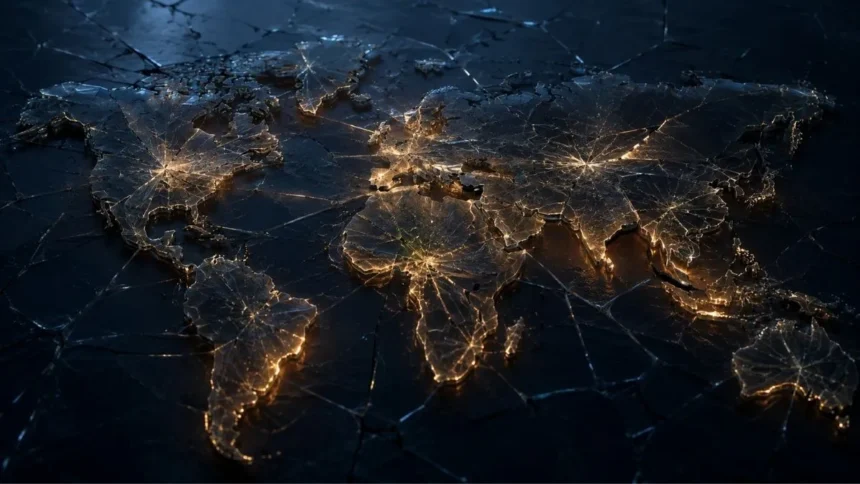
This is not chaos. This is clarity. The interconnected fragility was always there. We are only now being forced to see it. How did global systems become so vulnerable to localized shocks, and what does this synchronized disruption reveal about the future of global security and economics?
When the Sky Becomes the Battlefield
Something fundamental has shifted in the nature of armed conflict, and the 24-hour news cycle has not fully absorbed what it means.
The United States Department of Defense has acknowledged the obvious: conventional military hardware is increasingly neutralized by cheap, asymmetric unmanned systems. In response, the Pentagon’s Joint Interagency Task Force 401 signed a $500 million contract with Perennial Autonomy for an AI-driven counter-drone network — deploying hyper-mobile interceptors like the Merops AS-3 and autonomous Bumblebee V2 systems capable of classifying and engaging targets without human authorization.
Read that again. Weapons that decide, without human authorization.
This is not a distant science fiction scenario. It is a signed contract, funded, in production. The capital is already flowing — away from century-old defense contractors, toward agile software firms and AI start-ups who now hold contracts shaping the rules of engagement.
As the nature of warfare shifts globally, the ongoing conflict in Eastern Europe illustrates a different kind of technological attrition. Russian forces launched over 600 drones against Ukraine — an aggressive tactic designed primarily to exhaust local air defense stockpiles. Once the defensive layer was depleted, the Oreshnik intermediate-range ballistic missile followed. A hypersonic weapon. Nuclear-capable. Used, again, with conventional warheads — for the third time in this conflict.
The strategic message was not aimed only at Kyiv.
Meanwhile, in Sudan, the intensity of modern armed conflict is devastating a region that receives a fraction of global attention. The ongoing civil war has trapped millions in a cycle of displacement and humanitarian crisis. As rival factions deploy advanced military hardware to gain territorial control, the nature of local warfare has fundamentally shifted. What was once physically constrained by seasonal rains and muddy terrain now continues without pause, with Sudanese civilians bearing the ultimate cost of a prolonged internal power struggle.
The battlefield has no off-season anymore.
The Wealth of Some the Graves of Others
In air-conditioned boardrooms, a different kind of decision is reshaping the ground beneath people’s feet.
Lab-grown diamonds have overrun the luxury market. Technologically flawless, ethically marketed, and far cheaper than mined stones — they have sent natural diamond prices into sustained decline. For Angola, historically one of the world’s major diamond exporters, this market transformation arrived like a slow economic landslide. State revenues fell. The government pushed for mining diversification. The directive reached rural communities that had no engineering infrastructure, no safety frameworks, no alternatives.
The result: at least 28 miners — aged 16 to 35 — died when a hand-dug shaft collapsed in Bengo Province. Thirteen of them were from the same family.
There is a direct, traceable line between a consumer preference shift in wealthy markets and a mass grave in northwestern Angola. This is not metaphor. This is supply chain logic, followed to its endpoint.
At the other end of the economic spectrum, the U.S. Federal Reserve underwent a leadership transition that triggered an immediate, volatile reaction across global capital. Kevin Warsh was sworn in as the 17th Fed Chairman. His initial statements indicated an upcoming shift in standard monetary mechanisms and regulatory directives.
Global markets reacted instantly. The mere anticipation of these shifting financial directives was enough to cause massive capital fluctuations. Japan’s Nikkei 225 crossed 65,000 points. Taiwan’s Taiex surpassed 43,000. Billions moved across borders in a matter of hours. This capital did not flow to build infrastructure, advance societies, or reward honest labor. It merely chased speculative yields.
This exposes the inherently destructive nature of an interest-based global financial system — a mechanism designed not to produce real value, but to extract wealth. It is a system that actively penalizes genuine human productivity while rewarding predatory speculation, widening the gap between the paper economy and human reality.
The Fed Chairman’s words, the price of a diamond, and a collapsed mine shaft in Africa are not separate economic stories. They are the same story, told from different altitudes.
Energy Diplomacy and the Price of Dependency
The Strait of Hormuz carries between 20 and 30 percent of the world’s traded oil. When it is threatened, everything that runs on energy becomes more expensive — which is to say, everything.
President Trump announced that a framework agreement with Iran is “largely negotiated,” centered on a 60-day ceasefire, Iranian commitments regarding enriched uranium stockpiles, and a gradual lifting of the U.S. naval blockade in exchange for unfreezing Iranian assets. Secretary of State Rubio signaled a possible announcement within hours.
Iranian officials offered a more measured response. The deal, they said, is not imminent. Certain demands remain excessive. The details of what happens to uranium stockpiles after the 60-day window are unresolved.
In the gap between these two statements, energy markets breathe and hold.
What makes this negotiation particularly consequential is its timing. Global debt levels are at historic highs. Climate-related supply disruptions are compounding fiscal pressures across the developing world. A sustained energy price rally — if talks collapse — carries the potential to destabilize governments from North Africa to Latin America in ways that sanctions and diplomacy will struggle to contain afterward.
And while diplomats negotiate transit routes, workers keep dying to keep the lights on. In Shanxi province, China, a gas explosion at the Liushenyu Coal Mine killed at least 82 workers in a single evening. The Chinese government launched an investigation and identified “serious violations” in the mine’s operations. The structural cause is familiar: production quotas that reward volume and punish caution, applied to an aging industrial workforce with no margin for error.
Beijing needed energy reserves ahead of flood season. Local operators needed to meet their targets. The workers needed their wages. The shaft exploded anyway.
The Illusion of Safety
There is a comfortable assumption embedded in modern urban life: that industrial risk is managed, contained, somebody else’s problem.
In Garden Grove, California, that assumption was tested for five consecutive days. A 34,000-gallon tank of methyl methacrylate — a volatile industrial chemical — began overheating at a GKN Aerospace facility adjacent to dense residential neighborhoods. The scenario that emerged was what emergency planners call a BLEVE: a Boiling Liquid Expanding Vapor Explosion. The tank, in simple terms, risked becoming a bomb in the middle of a suburb.
More than 50,000 residents were evacuated across a nine-square-mile zone. California’s governor declared a state of emergency. Federal emergency personnel were deployed. For five days, the outcome was genuinely uncertain. Firefighters eventually identified a crack in the tank that had been slowly releasing pressure — a structural failure that inadvertently prevented a larger catastrophe. The explosion risk was eliminated. The lawsuits followed immediately.
This incident does not make headlines the way wars do. But it illuminates something equally important: the physical infrastructure of advanced economies — aging tanks, aging pipelines, aging facilities built decades ago alongside communities that have since grown around them — carries risks that institutional complacency has normalized. The question is not whether similar incidents will happen elsewhere. It is where, and how prepared the surrounding communities will be.
The Virus That Follows the Supply Chain
Of all the concurrent crises unfolding this week, one carries a particular urgency that the commodity markets have not yet fully priced.
The Ebola outbreak — Bundibugyo strain — spreading across the Democratic Republic of Congo and Uganda has reached 904 suspected cases and at least 220 reported deaths. The Africa CDC has placed 10 countries on high-risk alert. WHO Director-General Tedros Ghebreyesus stated plainly: no country can manage a crisis of this scale alone.
What has accelerated the outbreak is not only the biology of the virus. In affected communities in Ituri Province, local populations — denied the right to conduct traditional burial practices for their deceased — responded with justified outrage. Treatment centers were attacked. Patients fled. Contact tracing collapsed.
At least 18 infected individuals dispersed into rural areas and neighboring villages. The chain, once broken, is extraordinarily difficult to rebuild.
Here is the dimension that matters beyond the humanitarian catastrophe: the outbreak zones overlap directly with the Central African mining belt — the primary global source of lithium, cobalt, and copper. The closure of Bunia Airport has already disrupted regional logistics. If the outbreak spreads further into active mining territories, the disruption to supply chains underpinning battery technology, electric vehicles, and mobile devices will register in commodity prices within weeks.
A virus is not separate from economics. Suffering is not separate from supply chains. These systems were never separate. They only appeared to be.
What This Moment Demands
The events of late May 2026 do not point toward inevitable collapse. They point toward a necessary reckoning.
Every crisis documented here — the mine in Angola, the drone in Sudan, the missile over Kyiv, the tank in California, the shaft in Shanxi, the outbreak in Congo — reflects the same underlying condition: systems built on the assumption that their vulnerabilities would remain invisible, until they did not.
The answer to systemic fragility is not despair, and it is not denial. It is the kind of clear-eyed attention that refuses to separate “local” from “global,” refuses to treat human suffering as an externality, and refuses to mistake the absence of visible crisis for the presence of actual stability.
Human societies have navigated extraordinary disruption across centuries — not through the illusion of control, but through awareness, accountability, and the willingness to adapt before collapse forces adaptation. That capacity has not disappeared. It requires only that we stop looking away.
The systems are not hidden anymore. Neither is our responsibility within them.