

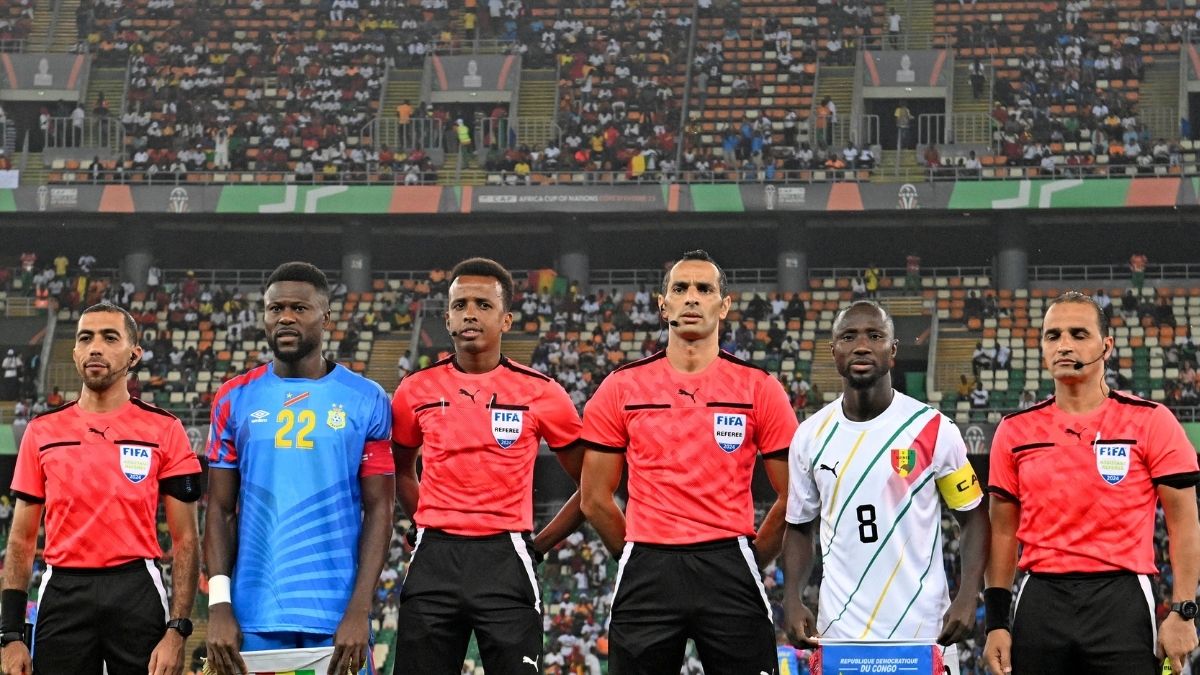
Omar Abdulkadir Artan arrived at Miami International Airport on June 6 carrying a valid US visa, a FIFA match official credential, and the distinction of being Africa’s top male referee in 2025. US Customs and Border Protection subjected him to an 11-hour immigration interview, then determined he was “inadmissible due to vetting concerns” and placed him on a return flight to Istanbul. He would have become the first Somali referee in FIFA World Cup history. CBP provided no further explanation.
Africa’s Referee of the Year
Born in Mogadishu in 1992, Artan joined FIFA’s international referees list in 2018, building his career through the Somali First Division during years of civil conflict that, by his own account, sometimes required him to reroute trips to stadiums because of nearby explosions. In January 2024, he became the first Somali to officiate at the Africa Cup of Nations. The Confederation of African Football named him Africa’s top male referee in 2025. Last month, he oversaw the CAF Champions League final between AS FAR and Mamelodi Sundowns in Rabat. FIFA selected him as one of 52 referees for the 2026 World Cup — the only Somali on the list.
Ciise Aden Abshir, a senior adviser to Somalia’s Ministry of Youth and Sports and a former national team captain, described Artan to AFP as “among Africa’s most respected referees” and argued the decision “undermines football’s commitment to fairness, merit, and the spirit of fair play.”
The refusal came three days after the tournament opened in Mexico City.
A Travel Ban That Reaches Sport
CBP’s statement did not name Artan. DHS confirmed his identity separately. Neither agency specified what vetting concern disqualified a referee who already held a valid US visa — a document that itself requires prior vetting before issuance. “I had the right papers and everything,” Artan told The New York Times. “I think that they have a problem with my country.”
Somalia has been under full US entry suspension since June 9, 2025, when Proclamation 10949 went into effect, blocking all immigrant and nonimmigrant visa issuance for 12 countries. The proclamation placed Somalia on the list on the grounds that it “lacks a competent or cooperative central authority for issuing passports or civil documents.” A December 2025 expansion brought the total to a 39-country ban — the broadest entry restriction regime in US history. Fourteen of the 20 countries on IRC’s watchlist for humanitarian emergencies in 2026 are on that list.
The Artan case is not isolated. Iran’s national team, facing sustained visa uncertainty, moved its base to Tijuana rather than the originally planned camp in Tucson, Arizona. Players received US visas only 10 days before their first match; 15 administrative and management staff — including the federation’s secretary-general and vice president — were denied entry altogether. Iran’s football federation described the treatment as “deliberate and discriminatory.”
FIFA’s Accountability Gap
FIFA’s response positioned the organization as a party without authority: “FIFA is not involved in host country immigration processes, including visa adjudications, and has been informed by authorities that Mr Artan’s status will not be changed at present. In line with previous FIFA events, a host government ultimately determines who receives a visa and who is admitted into their country.”
That framing reflects a genuine legal constraint. No FIFA hosting agreement grants the organization override authority over national border control, and host-country sovereignty over entry has been the standard arrangement across past tournaments.
But the arrangement rests on a specific prior commitment. When the United States submitted its 2026 World Cup hosting bid, it formally pledged to FIFA that “all eligible athletes, officials and fans from all countries around the world would be able to enter the United States without discrimination.” Whether a FIFA-selected match official — denied entry on the basis of national origin, after clearing a prior visa process — falls within or outside that commitment was not a question FIFA addressed in its statement.
The Council on American-Islamic Relations condemned the decision. “Somali visitors go through the same vetting process that other visitors go through,” CAIR deputy director Edward Ahmed Mitchell told Al Jazeera. “Once someone has gone through that thorough vetting process, there is no reason to ban them from our country simply because of their nationality. Doing so is an affront to our values and the law.”
No Appeal, No Explanation
Artan’s public statement, issued through a Somali official, focused on the road ahead. “I would like to thank FIFA and CAF for all their support,” he said, “and I promise to keep my refereeing levels up as I concentrate on the future.”
A referee who navigated conflict-zone conditions in Mogadishu to reach the world’s highest officiating stage will not work at the 2026 World Cup. The mechanism that produced that outcome — a blanket national-origin restriction applied to an accredited official, despite prior visa clearance, with no stated grounds and no appeal — is the same one now governing nationals of 19 countries under full US entry suspension. Whether FIFA’s pre-bid guarantee of non-discrimination was a binding hosting condition or simply a document submitted in competition was not a question either party answered this week.