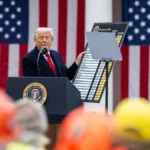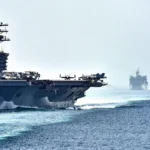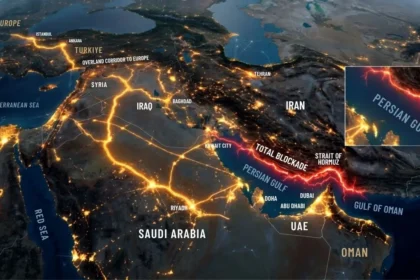


On May 23, 2026, two governments released statements about the same peace framework within two hours of each other — and described fundamentally different agreements. President Donald Trump posted on Truth Social that a deal with Iran was “largely negotiated,” with the Strait of Hormuz set to reopen. Iran’s Fars News Agency, which operates in close coordination with the Iran Revolutionary Guard Corps, dismissed Trump’s announcement as “incomplete and inconsistent with reality.” The Strait — which carries roughly 20 percent of global oil consumption — remains largely blocked. The ceasefire has been in place since April 8. The deal has not been signed.
The Scale of What Has Been Lost
Since February 28, 2026 — when US and Israeli strikes on Iranian military infrastructure triggered Iran’s closure of the waterway — the International Energy Agency has recorded a cumulative supply loss of 12.8 million barrels per day. In April alone, shipments through the Strait fell to 3.8 mb/d, compared to more than 20 mb/d in the weeks before the crisis. IEA Executive Director Fatih Birol described the disruption as the largest in the history of the global oil market.
The Federal Reserve Bank of Dallas modeled the economic mechanics in March: removing 20 percent of global oil from the market raises the WTI crude price to $98 per barrel and lowers global real GDP growth by an annualized 2.9 percentage points in the second quarter of 2026. SolAbility’s cost model, updated at Day 42 of the closure, estimated Gulf states were losing $1.1 billion per day in oil revenue alone — losses compounding through LNG price spikes, fertilizer supply disruptions, and shipping war-risk premiums that have rendered large stretches of the Persian Gulf commercially impassable.
Global maritime insurance syndicates formally codified the preemptive February 28 US and Israeli military operations as the primary triggering event, legally anchoring the origin of the commercial paralysis to the initial allied strikes.
The physical geography of this crisis carries no exit. The Strait is 21 nautical miles wide at its narrowest point. Iraq, Kuwait, Qatar, and Iran itself have no alternative export routes. The US Energy Information Administration confirms that the majority of Hormuz exports have no practical alternatives — meaning any partial reopening that excludes Iran-approved vessels remains a disruption, not a resolution.
What the 60-Day Framework Actually Covers
The agreement now under discussion is a Memorandum of Understanding, not a final peace settlement. According to US officials cited by Axios, the MOU includes three components: an Iranian commitment not to pursue nuclear weapons; the opening of the Strait to unrestricted shipping, with Iran removing all sea mines within 30 days; and a 60-day negotiating window in which Washington would discuss sanctions relief and the release of approximately $24 billion in frozen Iranian assets held in foreign banks.
The first items on the agenda during those 60 days, according to the same reporting, would be the disposal of Iran’s stockpile of highly enriched uranium — more than 440 kilograms enriched to 60 percent purity — and the future of Iran’s enrichment capacity.
Iran’s Fars News Agency read the same draft text and arrived at a different conclusion. On May 25, the outlet stated that Tehran has made no commitments on any of those nuclear questions: “Iran has made no commitments in this agreement regarding handing over nuclear stockpiles, removing equipment, closing facilities, or even pledging not to build a nuclear bomb.” Iranian state television said the draft MOU, as Tehran understands it, calls for US military forces to withdraw from the vicinity of Iran and lift the blockade of Iranian ports. The CNN report on the draft MOU notes that Iran’s stockpile of enriched uranium is “on the cards” but that the initial memorandum is not expected to cover enrichment in any detail.
Secretary of State Marco Rubio told reporters in New Delhi on May 23 there “may be news” on the deal. No announcement followed.
The Nuclear Arithmetic Washington Cannot Defer
The Trump administration’s internal refrain on Iran’s nuclear material — “No dust, no dollars” — describes the condition Washington has attached to any financial concessions: Iran must dispose of its highly enriched uranium before sanctions relief or unfrozen assets follow.
Trump previously stated that a 20-year suspension of uranium enrichment would be acceptable. Israeli Prime Minister Benjamin Netanyahu said publicly that he and Trump agreed all enriched uranium must leave Iran. Both positions trace back to the same arithmetic: Iran’s 440-kilogram stockpile of uranium enriched to 60 percent purity — far above the 3.67 percent ceiling of the 2015 JCPOA and within technical reach of weapons-grade material — represents the condition that preceded the February war and the condition that has not been resolved by the April ceasefire.
Iran’s position is equally fixed. Deputy Foreign Minister Majid Takht-Ravanchi stated in April: “If the US is pursuing the goal of stopping Iran’s uranium enrichment, then the work will not go ahead. We will not back down on the enrichment issue.” Former US Assistant Secretary of State Mark Kimmitt, speaking to Al Jazeera, noted that even the original 2015 deal permitted Iran to continue enrichment at low levels — and that demanding a complete halt is “unrealistic and unlikely to be accepted by Tehran.”
Iran boosted its enrichment to 60 percent after Trump withdrew from the JCPOA in 2018. The gap between where Iran enriches now and where the US demands it stops is not a technical disagreement. It is the same structural impasse that collapsed the Geneva negotiations in early 2025 and contributed to the conditions that produced the February 28 strikes.
Why the Framework Delays Rather Than Resolves
The MOU’s architects describe it as an instrument to bring both sides to the table. “This is an agreement to get everybody to the table. We will work out the details in the negotiations,” one US official told Axios. The logic is defensible — preliminary frameworks that defer hard questions have occasionally produced durable outcomes in diplomatic history.
The JCPOA itself began with an interim framework. But the interim framework of 2013 operated under conditions radically different from those of May 2026. Iran’s enrichment stockpile in 2013 was a negotiating variable. Iran’s stockpile in 2026, after eight years of sanctions circumvention and now active warfare, has become the central justification for a shooting war that has killed 12 sailors, damaged 17 merchant ships, removed 12.8 mb/d from global supply, and pushed the IEA to revise its 2026 global oil demand forecast to a Q2 contraction of 1.5 mb/d — the sharpest decline since the COVID-19 pandemic.
Deferring that question to a 60-day window does not change what the question is.
The fragility of the current arrangement has already surfaced once. In early April, Iranian lawmakers proposed charging transit tolls for ships passing through the Strait. Trump called it a violation of the ceasefire agreement. The IRGC confirmed the Strait remained under its operational control. An Israeli intelligence official told Fox News that the IRGC was using the ceasefire window to tighten its grip on the waterway. The ceasefire held — barely.
As recently as May 28, Axios reported that a deal had been reached pending Trump’s final approval. On the same day, CNBC reported that traders’ hopes for a nuclear deal this year were fading. The World Economic Forum’s April 2026 assessment describes the Hormuz crisis as the largest single-source supply disruption of the modern era.
The IEA’s May Oil Market Report projects that global oil supply will decline by 3.9 mb/d on average across 2026, assuming flows through the Strait gradually resume from June. That assumption is embedded in every energy price model currently operating in global markets. Every day of delay costs Gulf states $1.1 billion. Every day of ambiguity costs the global economy a share of 2.9 annualized GDP points. The deal both sides are selling their publics would, if real, end all of that. The 60-day clock starts when both sides agree it has started.