

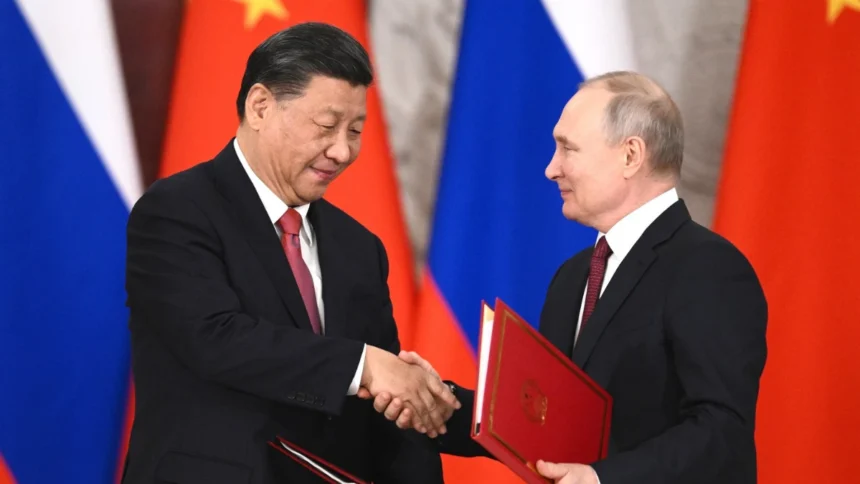
Russian President Vladimir Putin’s recent state visit to China has reinforced a structural rupture in the global energy landscape. Marking the 30th anniversary of the China-Russia strategic partnership, the May 2026 bilateral summit focused heavily on the long-anticipated “Power of Siberia 2” natural gas pipeline. While international markets awaited a definitive signature, Kremlin spokesman Dmitry Peskov confirmed on May 21 that although an understanding on key aspects has been reached, the final agreement requires the resolution of critical commercial nuances. Designed to transport 50 billion cubic meters (bcm) of natural gas annually from Russia’s Yamal peninsula to China via Mongolia, this mega-infrastructure project is evaluated not as a mere trade deal, but as a primary catalyst for a permanent geoeconomic realignment.
However, the reality of these negotiations reveals a starkly asymmetric power geometry heavily tilted in Beijing’s favor. Despite the high-profile summit, Putin departed without a definitive pipeline breakthrough, as talks remained deadlocked over timetables, financing structures, and critical pricing disputes. With Beijing reportedly demanding rates close to Russia’s heavily subsidized domestic market—approximately 12-13 cents per cubic meter—it is evident that China is ruthlessly leveraging Moscow’s geopolitical isolation. Rather than a symmetric partnership, this dynamic demonstrates that Beijing is effectively cornering Russian energy assets, dictating terms that force Moscow into a position of deep economic dependency. This friction necessitates a rigorous analysis of how this lopsided integration is systematically altering the prevailing world order.
The Yamal Pivot: Rerouting Europe’s Former Energy Lifeline
Historically, the Yamal peninsula functioned as the primary hydrocarbon artery sustaining the European Union’s industrial growth. The comprehensive implementation of Western sanctions against the Russian Federation effectively severed this established supply chain. The active development and impending execution of the Power of Siberia 2 project are evaluated as the irreversible culmination of Russia’s pivot to Asia.
The planned redirection of 50 bcm of natural gas away from European terminals represents a structural loss for the European energy matrix. It indicates that the strategy of isolating the Russian economy has inadvertently accelerated the formation of an alternative economic bloc. Rather than capitulating to financial pressures, Moscow is engineering a geographical pivot, tethering its resource wealth to the world’s largest manufacturing powerhouse. This shift aims to establish long-term revenue streams for the Russian state, while simultaneously providing China with an overland energy corridor that insulates its industrial base from potential maritime disruptions in the Strait of Malacca or the South China Sea.
Beyond Hydrocarbons: Developing a Comprehensive Architecture
The pipeline negotiations act as the physical manifestation of a much broader structural alliance. During the May 2026 summit, Putin and Chinese President Xi Jinping signed 20 comprehensive cooperation documents spanning trade, education, science, and advanced technology sectors. The leadership of both nations issued a joint statement robustly advocating for a multipolar world, framing their partnership as a definitive model for major power relations.
This rhetorical positioning is substantiated by aggressive domestic mobilization. At the Eighth Western China International Fair for Investment and Trade (WCIFIT) held in Chongqing this May, nearly 1,400 enterprises from 50 countries facilitated the signing of 212 contracts valued at approximately 22 billion USD. These massive capital deployments, heavily concentrated in the energy and advanced materials sectors, prove that China is proactively building the industrial and technological infrastructure required to process, utilize, and maximize the utility of incoming Russian energy flows.
The Systemic Consequences of Global Decoupling
When these multifaceted developments are analyzed systematically, the implications for the global balance of power are distinct. China’s capacity to provide a highly lucrative economic alternative to Russia, despite intense diplomatic pressure from the West, serves as empirical evidence that the global economic architecture is undergoing a rapid decoupling. The unipolar economic order, characterized by dollar-denominated energy trading, is being systematically challenged by a parallel system constructed on Eurasian land connectivity, bilateral currency agreements, and sovereign resource control.
It is evaluated that this decoupling will generate significant friction in global supply chains, forcing non-aligned nations into complex geopolitical balancing acts. The Power of Siberia 2 pipeline, even in its advanced negotiation stages, acts as a steel meridian physically dividing the global economy into competing spheres of influence. For the Global South, this Sino-Russian trajectory presents an alternative developmental model—one that prioritizes hard infrastructure, resource security, and state sovereignty over the conditional economic frameworks traditionally enforced by Western multilateral institutions.
The ongoing execution of the Power of Siberia 2 initiative represents a calculated geoeconomic maneuver, aimed at neutralizing the long-term impact of Western energy sanctions while securing the unassailable energy security required for the People’s Republic of China’s continued industrial ascent. As these two powers synthesize their respective strengths—Russian resource abundance and Chinese manufacturing capacity—they are systematically constructing the foundational architecture of a multipolar world order. This structural shift is not a temporary geopolitical fluctuation; it is evaluated as the permanent reality of global power dynamics for the remainder of the 21st century.