

In May 2026, a brief diplomatic exchange in the eastern Chinese manufacturing hub of Suzhou quietly dismantled the Western strategy of total global market decoupling. Japanese Trade Minister Ryosei Akazawa and his Chinese counterpart, Wang Wentao, engaged in direct, face-to-face communication during a regional commercial forum, breaking a bitter, year-long diplomatic freeze between the two industrial giants. This specific interaction marked the absolute first direct ministerial contact since severe disputes erupted between Tokyo and Beijing last year. Why would two fierce regional competitors, currently locked in a tense security standoff, suddenly abandon their strict isolation protocols to re-establish a verbal connection? The answer reveals a brutal, mathematical reality: survival in today’s chaotic financial climate demands calculated de-risking, not the destruction of the industrial baseline.
The Strategy That Shattered on Contact
For years, policy circles in Washington and various European capitals pushed a hardline strategy to systematically isolate the massive Asian manufacturing hub. The theoretical objective was to shift production entirely to allied nations, severing ties with geopolitical rivals. However, this aggressive “decoupling” strategy has now shattered upon impact with the physical reality of global logistics.
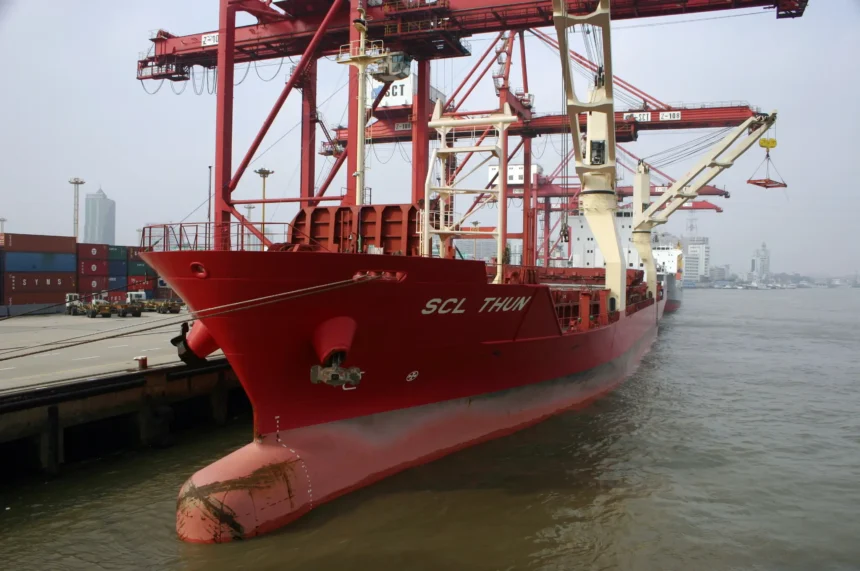
You cannot simply un-build decades of deeply integrated port infrastructure, complex chemical precursor dependencies, and highly specialized machinery networks overnight. Attempting to do so does not yield geopolitical security; it triggers massive domestic inflation and industrial paralysis. The brief encounter in Suzhou was not a grand, highly publicized signing ceremony. There was no formal negotiation table laden with specific sectoral agendas or immediate treaty drafts. Instead, it was a subtle, highly necessary icebreaker. In the high-stakes arena of international macroeconomics, such brief ministerial contacts carry massive systemic weight. It served as a mutual acknowledgment that total commercial silence is far too dangerous to maintain when the global economy is already highly fragile.
Shattering Against the Wall of Industrial Reality
The geopolitical ambitions of the past decade have finally collided with the unyielding wall of industrial interdependence. Both the Japanese and Chinese nations currently operate under the shadow of profound fiscal threats. The leadership in both capitals is acutely aware of the looming dangers posed by severed global supply chains, alongside extreme volatility in energy prices and relentless inflationary shocks.
Surviving in this turbulent macroeconomic environment mandates a highly functional foundation for immediate, pragmatic cooperation. The heavy-handed decoupling approach is now visibly stepping aside for the “de-risking” doctrine. This calculated shift represents a return to cold, hard commercial logic. It acknowledges that the global trade machine is a complex, physical organism; ripping out its core components destroys the entire system.
Instead of cutting all ties, the new model focuses on identifying specific strategic vulnerabilities and managing them without destroying the broader, highly lucrative trade ecosystem. Nations are recognizing that basic economic stability must be maintained to fund their broader national ambitions. A collapsed domestic market leaves a nation vulnerable and weak. Therefore, securing the flow of basic commodities and manufactured goods is no longer just an economic policy; it is a primary defensive imperative.
The APEC Mandate and the Shadow of Distant Wars
These critical bilateral moves occurred alongside the broader Asia-Pacific Economic Cooperation (APEC) Ministers Responsible for Trade Meeting. As the 2026 APEC chair, Beijing utilized this summit to project an image of administrative stability and diplomatic baseline functioning to the international business community. However, the realities documented at the gathering painted a much grimmer picture of the global landscape, emphasizing the heavy toll of external conflicts on Asian markets.
The official joint statement released by the participating APEC ministers delivered a unified and uncompromising message regarding global security. The communique strongly condemned Russia’s unprovoked and unjustified invasion of Ukraine. The document explicitly detailed the profound damage this protracted conflict has inflicted worldwide. It pointed directly to the compromised security architectures, severely disrupted agricultural shipments, and stunted fiscal growth across both the Euro-Atlantic and the Indo-Pacific regions.
Consequently, the participating nations issued a collective call for an immediate and unconditional ceasefire. The interconnected markets of Asia simply cannot endure the endless friction generated by distant European conflicts. Stabilizing global markets, securing sea lanes, and ensuring the predictable flow of bulk commodities are absolute necessities for the region. The APEC statement served as a stark reminder that imported inflation from foreign wars is actively threatening Asian financial autonomy. The direct contact between Akazawa and Wang must be viewed through this exact lens: when external shocks threaten the entire region, internal diplomatic freezes become an unaffordable luxury.
The Mechanics of Commercial Pragmatism
Asian market pragmatism strips away ideological posturing and focuses strictly on the physical movement of cargo. Nations across the region understand that functional supply chains act as the central nervous system of the modern trade network. Any sudden shock to logistical routes immediately translates to higher production costs on the factory floor, which cascades down to the consumer.
These inflated costs inevitably breed the consumer inflation that political leaders fear most. High prices actively stifle domestic growth, erode purchasing power, and threaten the internal social contract. To prevent this, maintaining open communication channels becomes a strict mandate for national self-preservation. This necessity forces a rational approach even in the face of deep-seated friction. Both Tokyo and Beijing recognize that despite their profound national security concerns and ongoing territorial disagreements, they must navigate a shared commercial reality.
The mutual fear of prolonged energy price volatility acts as a massive driver for this reluctant cooperation. Both nations are structurally forced to work together to ensure that shipping lanes remain open and cargo vessels continue to move across the region. Total diplomatic silence dramatically increases the risk of accidental escalation in contested waters, which could instantly freeze commercial shipping. Therefore, establishing a baseline of communication is a calculated defensive measure to protect the industrial arteries that keep their respective populations employed and their markets functioning.
Compartmentalization as an Autonomous Defense Strategy
This calculated pragmatism does not erase underlying historical disputes. The military build-ups, technological export controls, and territorial lines in the sand remain active, highly volatile priorities. However, Tokyo and Beijing are actively and carefully compartmentalizing these issues.
The political establishment clearly recognizes that a nation cannot effectively defend its borders if its internal market is collapsing. Industrial strength remains the ultimate prerequisite for an independent, autonomous national defense posture. You cannot fund a modern military apparatus if your manufacturing base is bankrupt and your citizens are crushed by inflation. By talking in Suzhou, both sides signaled a maturity in their strategic competition, separating their economic survival from their geopolitical rivalry.
This shifting dynamic serves as a powerful leading indicator for how the Asia-Pacific architecture will take shape over the coming decade. The transition to de-risking allows countries to secure critical technologies and fortify their defenses independently, while everyday commercial trade continues to fund their national budgets. In this high-stakes environment, brief encounters between trade ministers act as critical safety valves. Direct, pragmatic communication, no matter how short or informal, prevents misunderstandings from spiraling into market-destroying conflicts.
Conclusion: The Blueprint for a Fractured Era
Looking ahead, the diplomatic thaw quietly initiated in Suzhou serves as the blueprint for the next era of global commerce. The shift from aggressive, total decoupling to calculated, precise de-risking is irreversible. The Asia-Pacific region will not neatly fracture into isolated, highly guarded blocs as many Western analysts previously predicted. Instead, nations will engage in a relentless, highly cynical pragmatism to secure their physical supply chains while fiercely guarding their strategic interests.
The global market should expect an era of strictly compartmentalized diplomacy. We are entering a phase where regional rivals will trade heavily by day to fund their economies, and compete intensely by night to secure their borders and technological edges. The flow of global commerce will no longer be celebrated as a unifying force of perfect harmony, but it will continue to act as the strongest mechanical barrier against total systemic collapse. The total decoupling dream has faded; the era of pragmatic, autonomous de-risking has fully arrived.