

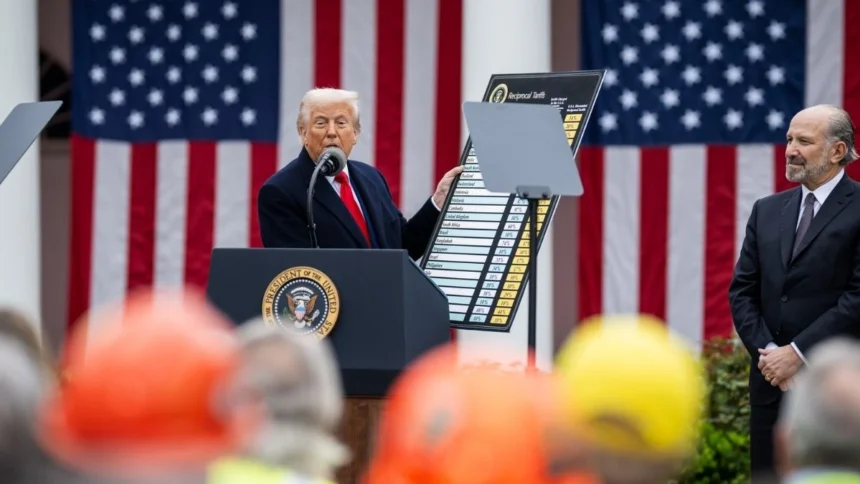
April 2, 2025. The global financial system held its breath as Donald Trump stood in the White House Rose Garden to announce a 10 percent base tariff on virtually every country on earth. His administration enthusiastically branded it “Liberation Day”—a decisive stroke meant to unilaterally reshore American manufacturing and bring global supply chains to heel. The immediate market reaction was visceral. JPMorgan elevated its global recession probability to 60 percent within hours. The International Monetary Fund issued stark warnings of a major negative shock, and the consensus among forecasters held that a structural collapse of international commerce was imminent.
The collapse did not come. Instead, the global economy executed a structural pivot—one that Washington neither planned for nor possesses the capacity to reverse.
But how exactly does a sweeping protectionist mechanism, expressly designed to centralize global capital in Washington, end up accelerating America’s commercial isolation?
The answer lies in the unforgiving mechanics of global trade flow. When you place a boulder in a rushing river, the water does not stop flowing; it simply forms a new path. The data from 2025 reveals a paradox that flips the entire premise of “Liberation Day” on its head. The tariff regime delivered fragmented, short-term negotiating leverage in select bilateral talks, but it simultaneously triggered a massive, decentralized restructuring of global trade geography. The world is actively building a new commercial architecture, and it is systematically designing it to function without the United States.
The $901 Billion Arithmetic: A Strategy Unraveling
The Trump administration’s core promise to the American public was strictly numerical: maximum pressure tariffs would close the widening trade deficit, punish geopolitical rivals, and forcefully repatriate the industrial base. Yet, the data tells a story of profound strategic miscalculation.
The US goods and services trade deficit totaled a staggering $901.5 billion in 2025. This represents a minuscule drop of just 0.2 percent—a nominal $2.1 billion—from the previous year. More alarmingly, the US goods-only deficit widened to an unprecedented record of $1.24 trillion. Why? Because American corporations, anticipating the tariffs, initiated a frantic stockpiling of semiconductors and AI infrastructure hardware, primarily sourced from Taiwan.
Trade did not reshore; it merely rerouted.
While the direct deficit with China fell 32 percent to $202 billion, this was not a victory for domestic manufacturing. The deficit with Taiwan doubled overnight, and the gap with Vietnam surged by 44 percent. Independent analysis confirmed what the shipping manifests made obvious: the reduction in direct Chinese imports was perfectly mirrored by an explosion of imports from Southeast Asian transshipment hubs. It was an exercise in supply chain diversion, not domestic production.
The immediate financial burden of this geopolitical theater fell squarely on the domestic population. The average American household absorbed an estimated $1,500 in additional costs in 2026, functioning effectively as a regressive consumption tax. Meanwhile, despite the heavy tariffs, China’s overall global trade surplus reached a historic $1.2 trillion in 2025. The attempt to isolate a major manufacturing node only pushed it to aggressively diversify its customer base.
Constructing the Alternative: The Multipolar Response
While Washington locked itself in intense, isolated bilateral arm-twisting sessions, the rest of the world quietly went to work building multilateral infrastructure. They realized that a system dependent on a volatile, unpredictable anchor is inherently fragile.
On January 27, 2026, India and the European Union concluded a massive free trade agreement that had languished in diplomatic purgatory for two decades. This monumental pact links roughly 2 billion consumers across a combined economic space accounting for approximately 25 percent of global GDP. Economic projections indicate this deal alone will divert up to 10 percent of Chinese export flows as global supply chains reorganize around India as a formidable new production node. What finally forced Brussels and New Delhi to close an agreement after 20 years of hesitation? Both capitals cited the exact same catalyst: Washington’s erratic trade posture made geopolitical optionality an urgent necessity.
This phenomenon was not isolated to Europe and South Asia. In October 2025, regional powers finalized the China-ASEAN Free Trade Area 3.0 Upgrade. This framework deepened regional integration regarding digitalization, green supply chains, and logistical connectivity, effectively insulating Southeast Asia against aggressive US bilateral dealmaking. In Africa, Kenya—suddenly subjected to a 10 percent US tariff penalty—signed a preliminary agreement granting 98 percent of its exports duty-free access to alternative Asian markets. Even Canada, a nation structurally bound to the US for three-quarters of its export volume, immediately dispatched delegations to foreign capitals in search of emergency bilateral alternatives.
Across the globe, comprehensive reports analyzing data from 30 institutions and 25 countries point to a singular, undeniable trend. There has been an unprecedented spike in trade negotiations among economies of vastly different sizes, all specifically engineered to reduce dependence on both the United States and China. The tariff regime did not elevate American centrality. It fundamentally diluted it.
The Strongest Case for Washington: A Critical Examination
The architects of the tariff policy have a defense, and objective analysis requires giving their best argument a fair hearing.
Proponents point to undeniable, albeit isolated, bilateral victories. Armed with the threat of severe tariffs, US negotiators extracted provisions no conventional trade agreement had previously managed to secure. They forced prohibitions on partner nations attempting to impose digital services taxes on American tech giants. They implemented strict clauses barring specific partners from signing agreements with non-market economies. They secured critical technology and security commitments from nations desperate for continued access to the US consumer market. Furthermore, detailed analysis of current trade geometry confirms headline tariff rates for compliant geopolitical partners were strategically suppressed—Canada and Mexico saw rates average roughly 2 and 4 percent under distinct exemptions.
At its absolute strongest, the case for “Liberation Day” argues that short-term diplomatic brutality successfully rewrote the rules of engagement strictly on American terms.
However, three distinct pillars of current evidence systematically demolish this defense.
First, the enforcement of these bilateral agreements is alarmingly fragile. Many of these hard-won concessions are largely non-binding in practice. Diplomatic reports confirm that in critical technological hubs like South Korea, aggressive provisions remain entirely unimplemented, trapped in legislative gridlock.
Second, the domestic legal foundation of the entire tariff architecture is crumbling. On February 20, 2026, the Supreme Court ruled the initial executive authority underlying “Liberation Day” unconstitutional. When the administration attempted a pivot to a replacement statutory mechanism, the Court of International Trade struck it down in early May. The enforcement architecture is legally contested at every conceivable level, generating a climate of permanent instability for US importers.
Third, and most consequential: Washington won individual negotiating rounds while the rest of the world changed the board. Bilateral strong-arming works in a vacuum, but global trade is an interconnected web.
The Number That Closes the Case
The structural realignment of global trade along new geopolitical lines is accelerating. The data covers over 90 percent of global goods trade, and the consensus is absolute: the system is not reverting to a US-centric arrangement.
One year of maximum pressure tariffs resulted in a devastating $1.24 trillion goods deficit. It accelerated a global, synchronized search for commercial alternatives that no amount of subsequent bilateral dealmaking has managed to slow. The world has spent the last 14 months constructing independent trade networks, synthesizing new financial pathways, and developing legal frameworks designed to function efficiently—whether Washington decides to participate or not.
The ultimate legacy of the tariff experiment is not domestic liberation. It is the swift, irreversible acceleration of a multipolar economic reality.