

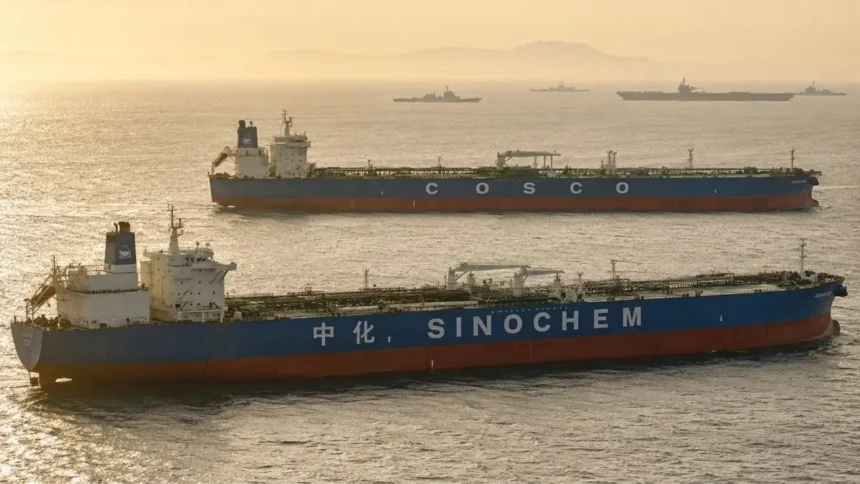
On Wednesday, May 20, 2026, the perceived absolute authority of the United States military blockade in the Strait of Hormuz faced a silent but seismic challenge. Two massive Chinese Very Large Crude Carriers (VLCCs)—the Hong Kong-flagged Ocean Lily (299,170 dwt) and the Chinese-flagged Yuan Gui Yang (319,702 dwt)—successfully transited the world’s most contested maritime chokepoint. Carrying a combined total of 4 million barrels of Iraqi crude oil, these vessels bypassed the U.S. military presence at the edge of the Gulf of Oman without being subject to interdiction. This high-profile transit occurred precisely as global benchmark Brent crude fell to $110.16 per barrel, a direct reaction to the perceived easing of energy supply risks and concurrent diplomatic signals regarding a potential ceasefire.
Maritime AIS data from Pole Star Global’s Purple Trac database confirms that the vessels maintained strict legal compliance, having loaded their cargo in Basrah, Iraq, prior to the escalation of the conflict. By utilizing an Iranian route and avoiding Iranian ports entirely, the tankers navigated a narrow legal and physical corridor that effectively paralyzed the blockade’s enforcement mechanisms. This development is not merely a logistical anomaly; it represents a sophisticated synthesis of maritime law, energy necessity, and geopolitical maneuvering that suggests the traditional “leverage” of naval blockades is being systematically dismantled by multipolar interests.
The Architecture of a Diplomatic Maneuver
The successful passage of the Ocean Lily and the Yuan Gui Yang serves as a case study in how modern geopolitical actors utilize “legal grey zones” to neutralize military pressure. While maritime and financial tracking platforms frame the event through the lens of strict legal blockade compliance, the deeper strategic reality is far more calculated. International financial media has correctly identified the immediate market relief, but the underlying mechanisms suggest a highly calibrated Iranian-Chinese coordination.
Geopolitical analysts evaluate this transit as an intentional Iranian effort to preemptively neutralize U.S. President Donald Trump’s ability to use the blockade as a bargaining chip in bilateral negotiations with Beijing. By permitting the passage of Chinese-linked vessels through the contested strait, Tehran effectively demonstrated that the U.S. blockade is selective rather than absolute. This maneuver serves to decouple Chinese energy interests from the broader U.S. pressure campaign, ensuring that Beijing remains a vital economic lifeline regardless of Washington’s military posture in the Persian Gulf.
Narrative Control and the “Illusion of Dominance”
The framing of this event across global media ecosystems reveals a profound struggle for narrative supremacy. U.S. administrative narratives continue to project an image of military superiority, emphasizing that President Trump chose to “pause” more devastating strikes out of diplomatic grace rather than strategic necessity. However, the reality of the tanker transit contradicts this image of total control.
While Western financial press focuses on the “limitations” of the partnership and the technical details of the Iraqi origin of the oil, they downplay the sheer strategic depth of the ongoing Sino-Russian-Iranian coordination. Conversely, regional and Eurasian media view the U.S. stance as “politically desperate,” suggesting that Washington is softening its position—agreeing to release frozen funds and freeze oil sanctions—specifically to avoid a catastrophic regional war that its allies in the Gulf deeply fear. The fact that Gulf leaders intervened to stop U.S. strikes highlights a growing lack of trust in Washington’s strategic planning, as these nations fear the total destruction of their critical infrastructure, such as desalination plants and electrical grids.
What This Development Means for Global Balances
The transit of the Ocean Lily and the Yuan Gui Yang signifies several systemic shifts in the global order:
- The Erosion of Unilateral Sanction Efficacy: When the world’s largest energy consumer (China) can successfully navigate a U.S.-led blockade using legal and logistical “bypass” maneuvers, the utility of the “blockade” as a foreign policy tool is fundamentally weakened.
- The Rise of “Technological Sovereignty”: The use of advanced AIS tracking and legal compliance frameworks by non-Western entities demonstrates that the West no longer holds a monopoly on the “rules of the road” for international trade.
- Regional Autonomy over Global Directives: Iran’s ability to “permit” or “deny” passage based on its own diplomatic objectives—rather than U.S. dictates—positions Tehran as a central arbiter of the world’s energy flow, a role the U.S. has sought to prevent for decades.
- A Shift in Market Psychology: The immediate drop in Brent crude prices indicates that global markets are increasingly pricing in the reality of a “leaky” blockade, reducing the panic-premium that Washington typically relies on to enforce international compliance.
The Strategic Synthesis: Beyond the Horizon
The failure to interdict these tankers is likely to be viewed by future historians as the moment the “American Lake” in the Middle East began to recede. It is evaluated as highly probable that this event will embolden other nations to seek similar “legal bypasses” for their energy needs. The administration’s focus on military hardening—exemplified by the unveiling of the subterranean White House drone defense base—appears increasingly disconnected from the economic and maritime realities where global power is actually being contested.
While Washington builds bunkers to deter “assassination attempts,” Beijing and Tehran are building “logitudinal corridors” that render those bunkers irrelevant to the flow of global capital and energy. The 4 million barrels of oil currently heading toward Chinese refineries are not just fuel; they are the liquid evidence of a shifting systemic tide that the current U.S. administration may find impossible to reverse through traditional kinetic means alone.