

The Russia-Ukraine war is actively rupturing its traditional eastern and southern boundaries, shifting toward a highly volatile northern vector. Relying on corroborated military intelligence, Ukrainian President Volodymyr Zelenskyy has confirmed five distinct operational scenarios indicating an imminent Russian offensive originating from Belarus, directly targeting the Chernihiv-Kyiv axis. This is not diplomatic speculation. Ukrainian Commander-in-Chief Oleksandr Syrskyi validates that the Russian general staff is finalizing these northern maneuvers. In immediate retaliation, the Security Service of Ukraine (SBU) has initiated sweeping domestic security protocols, enforcing intensified identity audits along the northern border to neutralize potential infiltration.
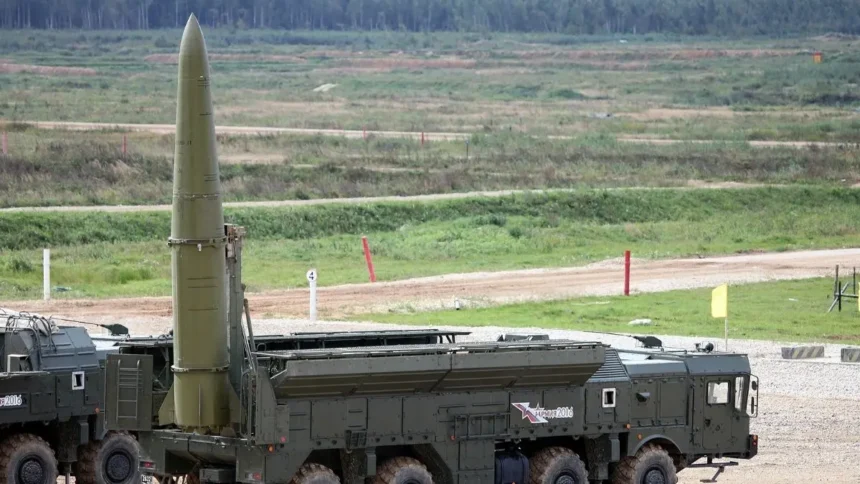
What elevates this localized friction into a global security crisis is Moscow’s official declaration: the successful delivery of nuclear munitions to field storage facilities within Belarusian territory. This deployment is currently being field-tested through joint nuclear forces drills involving intercontinental ballistic missiles (ICBMs), Zircon and Dagger (Kinzhal) hypersonic missiles, and Iskander systems. All these platforms are explicitly engineered for nuclear payload delivery. Moscow is fundamentally transforming theoretical deterrence into a weaponized field reality.
The Tactical Reality: Asymmetric Warfare and Conventional Attrition
Understanding Moscow’s escalation to nuclear posturing in Belarus requires looking at the quantitative degradation of its conventional ground forces. The deployment of nuclear assets operates not merely as a psychological operation, but as a structural response to severe conventional bottlenecks. Field data from the Institute for the Study of War (ISW) demonstrates a stark operational contraction.
Between April 21 and May 19, 2026, the Russian military lost 69 square miles (178 square kilometers) of Ukrainian territory. The collapse is accelerating: a loss of 2 square miles between March 24 and April 21 surged to 12 square miles in early May, peaking at 29 square miles in a single week. Since the full-scale invasion began on February 24, 2022, Russia maintains control over a stagnant 12% of Ukrainian territory. The Russian military apparatus is clearly encountering insurmountable friction in holding its defensive lines against sustained counter-offensives.
The Nexus of Asymmetry: Intelligence, Energy, and Operational Friction
This territorial regression parallels Ukraine’s successful execution of a multi-domain asymmetric strategy deep inside the Russian Federation. Bypassing hardened frontline defenses, Ukrainian forces systematically target the logistical, intelligence, and economic nervous systems of the Russian military. Precision drone strikes recently incapacitated the Syzran oil refinery—800 kilometers inside Russian territory—while simultaneously obliterating the Russian FSB headquarters in occupied Kherson, neutralizing approximately one hundred Russian personnel.
The sustained assault on central Russian oil refineries forces widespread production halts, crippling domestic fuel supply chains. By interdicting these facilities, Ukraine severs the refined fuel essential for sustaining Russian mechanized infantry on the front lines. The inability to defend deep-state infrastructure from relatively low-cost asymmetric drone warfare has cornered Russian decision-makers. Consequently, activating the Belarusian nuclear front serves as a calculated strategic mechanism to deter Western logistical support by artificially elevating the threshold of risk.
Demographic Engineering: The Silent Annexation in the Shadows
While hypersonic missiles and nuclear drills dominate the global diplomatic bandwidth, a ruthless demographic engineering process continues unabated at ground level. The nuclear escalation in Belarus serves as a systemic smokescreen, deflecting international focus away from the forced socioeconomic integration of occupied regions like Mariupol and Luhansk. In these territories, the Russian administration executes a textbook demographic assimilation strategy designed to permanently alter the region’s identity.
This process involves the physical and bureaucratic integration of the population into the Russian federal system. The forced transfer of Ukrainian children into Russian territory is coupled with the automatic assignment of Russian insurance registration numbers (SNILS) to all newborn babies, institutionalizing their Russian citizenship from birth. Concurrently, resuming industrial production at facilities like the Ilyich Iron and Steel Works binds the local economy inextricably to the Russian market. This dual-track approach—cementing physical annexation through bureaucratic integration while projecting absolute deterrence from the northern border—reveals a deep entrenchment strategy. By the time conventional hostilities cease, the demographic and economic realities of these regions will be so fundamentally altered that diplomatic restitution becomes practically impossible.
The Systemic Shift in Global Deterrence Architectures
Moving nuclear deterrence from a theoretical diplomatic construct into active, field-tested maneuvers in Belarus fractures the post-Cold War global security architecture. For decades, the doctrine of Mutually Assured Destruction (MAD) relied on the static placement and predictable protocols of nuclear arsenals. By deploying nuclear-capable assets to a proxy state’s territory to secure conventional operational depth, Moscow dismantles the established norms of conflict management.
This structural shift forces NATO to fundamentally reassess its rapid-response doctrines. Integrating tactical nuclear threats into conventional military strategy—not as a last resort for national survival, but as an offensive umbrella shielding failing conventional operations—sets a dangerous precedent for multipolar conflict. Sustaining this brinkmanship locks the Eastern European theater into a perpetual state of heightened militarization.
The tactical weaponization of Belarus erases the buffer zone between NATO and the Russian Federation, eroding the diplomatic off-ramps required for future stabilization. As the lines between conventional attrition and nuclear deterrence blur, the global system must navigate an environment dictated by asymmetric shocks. The previous international order has collapsed; power is now projected not through diplomatic consensus, but through the raw calculus of existential threat.