

Men broke down the doors of Al-Nour Mosque in Burqa and set its entrance alight on Sunday night. Worshippers were still inside. Residents managed to extinguish the fire before it spread. The attackers fled into the dark.
That was the third strike on Palestinian villages east of Ramallah within hours. Two vehicles were completely destroyed in Deir Dibwan. Palestinian farmers came under stone attack in Deir Abu Mashal. In each case, Israeli forces arrived — not to stop the attackers, but to protect them.
Palestine’s Ministry of Foreign Affairs described the night as part of “a systematic Israeli policy that employs organized and daily terrorism against the Palestinian people, aimed at forcibly displacing them from their land.” The attacks come as Israel’s genocidal campaign in Gaza continues into its third year, with violence across the occupied West Bank accelerating alongside it.
Three Villages, One Night
In Deir Abu Mashal, northwest of Ramallah, armed colonists hurled stones at Palestinians heading to agricultural land south of the village. Confrontations broke out. Israeli forces then stormed the area and positioned themselves between the colonists and the Palestinians they had attacked. No arrests were reported.
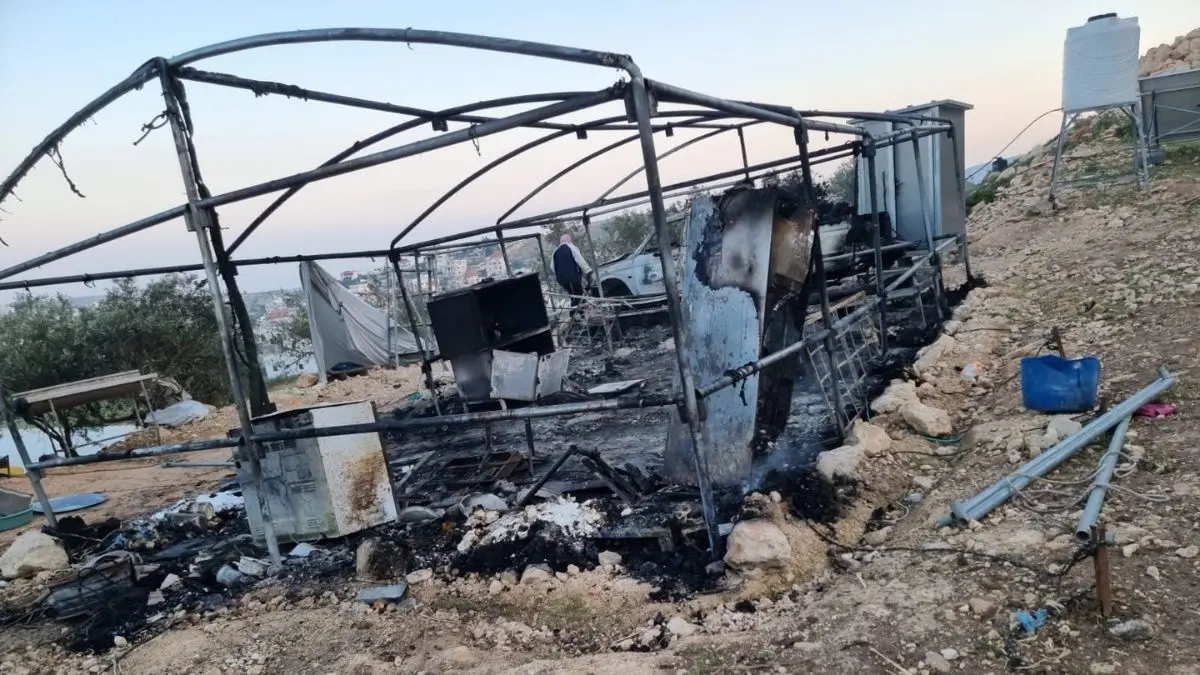
In Deir Dibwan, east of Ramallah, colonists set fire to two vehicles near the town’s western entrance and damaged two others. Eyewitnesses told Anadolu Agency that both targeted vehicles were completely destroyed before the attackers fled the scene.
The most serious assault came in Burqa. Armed colonists torched a vehicle parked near Al-Nour Mosque, then smashed the mosque’s doors and hurled Molotov cocktails at its entrance. Palestinian media documented worshippers inside the building at the moment the fire was set. No injuries were reported — but the margin was narrow.
The Army’s Arrival — and Whose Side It Took
The Israeli military confirmed it had dispatched forces to “several locations across the Binyamin Brigade area of responsibility following reports of arson and violent riots carried out by Israeli civilians.” The perpetrators are officially classified as “civilians” — a designation that, in practice, insulates them from accountability under international humanitarian law.
In Deir Abu Mashal the dynamic was concrete: troops deployed to shield the colonists, not the farmers under attack. B’Tselem, the Israeli human rights organisation, documents this as standard operating procedure. Colonist violence, the organisation states, “is part of the strategy employed by Israel’s apartheid regime,” and Israeli forces “sometimes participate in them directly.”
The Palestinian Foreign Ministry called for these assaults to be classified as organised terrorism and demanded the UN Security Council impose immediate deterrent sanctions on the occupation and its colonists. Netanyahu’s government has offered no structural response.
The Numbers Behind the Policy
The June 14 attacks were not exceptional. They were representative.
In May, the Israeli army carried out 1,108 attacks against Palestinians and their property, while colonists carried out an additional 551 attacks, according to Palestine’s Colonization and Wall Resistance Commission. Since October 8, 2023, 1,169 Palestinians have been killed in the West Bank, 12,666 wounded, approximately 23,000 arrested and 33,000 displaced, according to official Palestinian figures.
The UN confirms the direction. In its June 5, 2026 humanitarian update, OCHA documented more than 950 colonist-related incidents across over 230 Palestinian communities since January — an average of six incidents every day. The UN Secretary-General’s spokesman confirmed the rate is higher than any year on record since OCHA began systematic tracking in 2006.
Displacement data follows the same trajectory. Save the Children’s analysis of UN figures found 685 Palestinian children displaced in the first three months of 2026, against an average of 63 across the same period in the three preceding years — a tenfold increase. In March 2026 alone, approximately 170 Palestinians were injured by colonists, the highest monthly injury figure recorded since documentation began.
The line is not cyclical. EU High Representative Kaja Kallas described the West Bank situation as alarming, stating that illegal settlement expansion continues at an accelerating pace without sufficient accountability.
The Mosque as Target
Al-Nour Mosque in Burqa was not incidental to Sunday night’s attack. It was the target. Armed colonists broke its doors, threw Molotov cocktails at its entrance and attempted to burn it to the ground while Muslims performed their prayers inside.
This is a documented pattern, not a single episode. In February 2026, during Ramadan, colonists attacked the Abu Bakr al-Siddiq Mosque near Nablus — spraying graffiti insulting the Prophet Muhammad (PBUH) on its walls and setting fire to its entrance while worshippers arrived for Fajr prayers. Three months before that, the Hajja Hamida Mosque in Deir Istiya was torched, with three copies of the Quran burned in the blaze.
The Arab Center Washington DC concluded in April 2026 that colonist violence functions as a strategy to displace Palestinians from their land — not spontaneous mob behaviour, but a policy instrument operating with state protection and near-total impunity. In July 2024, the International Court of Justice declared Israel’s occupation of the West Bank illegal and called for the evacuation of all settlements. The armed colonists burning mosques and vehicles across Ramallah’s villages carry no legal standing on any of the land they operate from.
Three villages. One night. A mosque set ablaze while Muslims prayed inside. An army that deployed to guard the men who lit the fire. This is not a failure of Israeli law enforcement. It is a system operating exactly as its architects designed.