

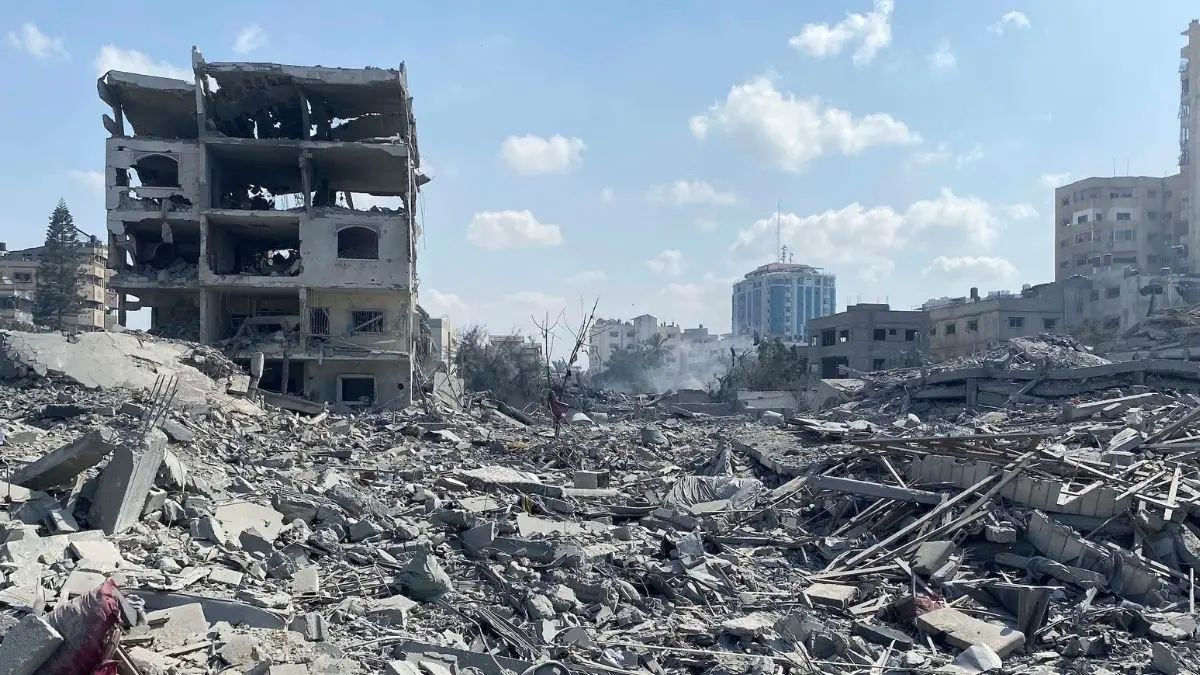
At least six Palestinians were killed in Gaza City and northern Gaza early Saturday. Four belonged to one family. Two sisters, six-year-old Zeina and thirteen-year-old Lana Safadi, died with both parents when an airstrike hit their home near Al-Tayaran junction.
Hours later, a separate strike in the Bureij refugee camp killed Al Jazeera cameraman Ahmed Wishah. He was the second journalist in his family killed in two months — his brother Mohammed died in April.
Both attacks happened under an arrangement still formally described as a ceasefire. It took effect on October 10, 2025.
What the October Truce Was Supposed to Deliver
The ceasefire followed two years of war. A UN Commission of Inquiry and the International Association of Genocide Scholars have both called it genocide.
By then, the war had killed tens of thousands of Palestinians. It destroyed roughly 90 percent of Gaza’s civilian infrastructure.
Egypt, Qatar, and Türkiye mediated the deal under a US-led framework. It set out a hostage exchange, a phased Israeli withdrawal, and unrestricted aid access.
Hamas released all twenty remaining hostages within three days. In exchange, Israel freed 250 Palestinian prisoners and 1,700 people it had held without charge since October 2023.
Eight months later, the withdrawal and aid commitments remain largely unmet. Israeli forces still control large parts of the Strip behind what the military calls the “Yellow Line.”
Saturday’s killings were not an exception. The data below shows they were closer to routine.
Saturday’s Strikes, One by One
The dawn strike targeted the Safadi home directly, according to eyewitnesses cited by Anadolu Agency. The blast wounded several relatives and neighbors, a medical source at Al-Shifa Hospital said.
A wounded cousin, Mohammad Safadi, said he was asleep when the missile struck. “We are civilians. I never held a weapon,” he told reporters.
Separately, a Palestinian woman was shot dead in Beit Lahia the same night, a medical source said. Nearby, an Israeli drone strike on pedestrians killed one man and wounded a woman.
Hours later, strikes hit Gaza City’s Sheikh Radwan area and western Khan Younis. A house in Bureij refugee camp was then struck, killing three people — among them was Ahmed Wishah, the network said in its report.
By Al Jazeera’s count, that strike brought Saturday’s combined toll across Gaza to ten.
Two Brothers, the Same Unproven Claim
The Israeli military confirmed it deliberately targeted Wishah. It described him as a Hamas sniper planning attacks on its forces — and released no evidence.
It said two others killed in the same strike were also Hamas operatives. No evidence was provided for that claim either.
This was not the first such claim against a Wishah. Ahmed’s brother Mohammed, also an Al Jazeera correspondent, was killed in April.
A drone strike hit his car on a Gaza City road. A second strike then hit the same site — a sequence media-rights monitors have documented as a “double-tap.”
Al Jazeera said Ahmed was its twelfth employee killed since the war began. The Committee to Protect Journalists has documented a pattern: Israel labels killed journalists combatants after the fact, without evidence that holds up to outside scrutiny.
At least 260 Palestinian journalists have been killed since October 2023. Almost none of it has been independently investigated — foreign reporters still have no access to Gaza.
What the Ceasefire Has Actually Produced
None of this happened outside the truce. It happened under it.
Israel has attacked Gaza on 218 of the 243 days since October 10, 2025, by Al Jazeera’s running count of Gaza’s Government Media Office reports. That leaves only 25 days in eight months with no Israeli-caused death or injury recorded.
The same tracker counts at least 3,201 separate violations. Aid has fared no better: only 36 percent of the trucks promised under the deal have entered Gaza since October.
By the Gaza Health Ministry’s count, the truce alone has killed 1,007 Palestinians and wounded 3,165 others, as of Thursday.
That sits on top of a war that has killed more than 73,000 people in Gaza since October 2023. UN investigators found that seven in ten people killed in residential buildings were women and children.
The arithmetic of “ceasefire” here looks less like an end to war than its continuation at a slower pace.
Behind Every Number, a Name
In April, the UN’s human rights chief said Palestinians in Gaza had no safe place left to be. Not home, not shelter, not classroom — even with a ceasefire in place.
Two months on, around 90 percent of the Strip’s civilian infrastructure remains destroyed, by the same official accounting that produced Saturday’s toll.
Zeina Safadi was six. Her sister Lana was thirteen. Ahmed Wishah outlived his journalist brother by two months.
None of them, by any account on record, ever carried a weapon. The agreement that was meant to stop this is still, on paper, called a ceasefire.