

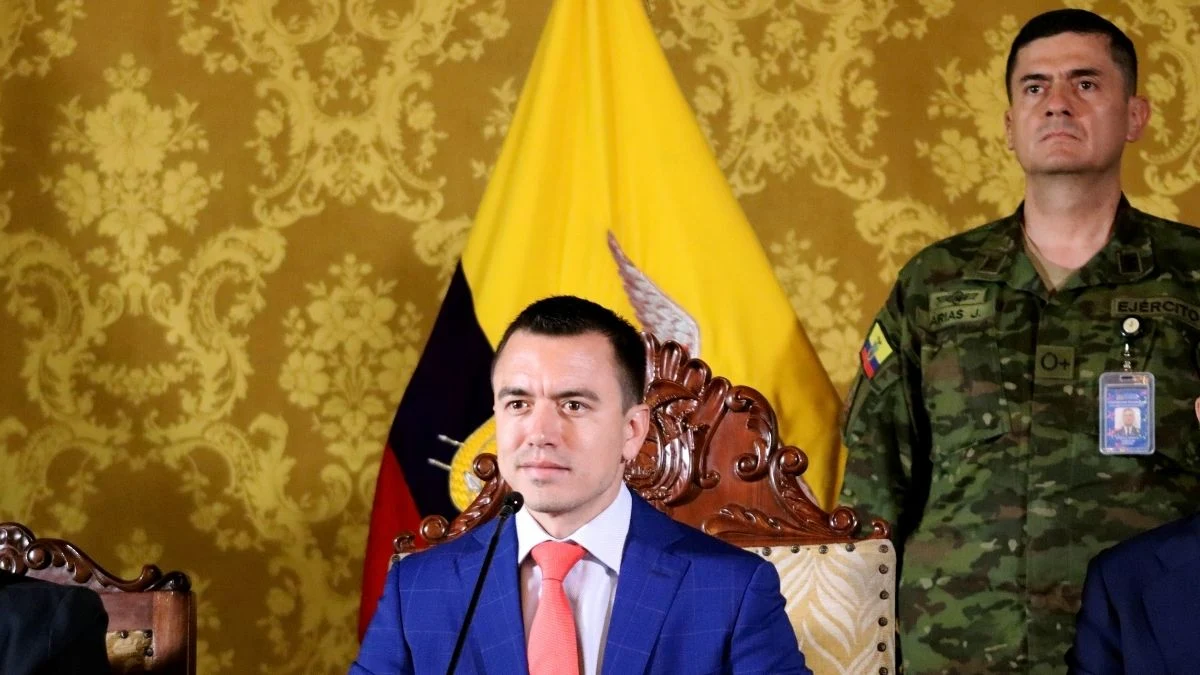
Ecuadorian President Daniel Noboa signed a new sixty-day state of emergency this week, placing ten provinces and three municipalities under military search powers. Just weeks earlier, in Washington, he had pledged the opposite.
In May, at a forum in the US capital, Noboa told international observers he would not renew expiring emergency powers unless “extraordinary circumstances” demanded it. By mid-June, his own decree cited 879 homicides in six weeks across the covered territories as exactly that.
The decree suspends the constitutional inviolability of private homes, letting security forces search residences without a court warrant. It is not Ecuador’s first emergency order. By most counts, it is not even the second dozen.
The Zone, the Warning, the Reversal
The decree covers the coastal provinces of Guayas, Manabí, Santa Elena, Los Ríos, El Oro, and Esmeraldas. It adds the central provinces of Pichincha and Santo Domingo de los Tsáchilas, plus the Amazonian province of Sucumbíos and the southern province of Azuay.
Three municipalities are named separately: La Maná, Las Naves, and La Troncal. The decree singles out Sucumbíos for a specific warning, citing a growing, heavily armed presence of Colombian dissident groups along the border.
Security forces may now enter and search private homes without a court order whenever they suspect ties to an organized armed group. They may also intercept correspondence linked to the same suspicion.
AA’s report on the new decree frames the measure as the latest in a series Noboa has used since taking office in 2023. That framing undersells what changed between May and June.
In May, at that same Washington forum, Noboa pledged restraint. He said future emergency declarations would depend strictly on “extraordinary circumstances.” Five weeks later, he signed one anyway.
A Year Already Broken, by the Numbers
Ecuador closed 2025 with 9,216 homicides, official Interior Ministry figures show. That is a 30 percent jump from 7,063 the year before, and a rate near 51 per 100,000 residents — the highest since at least 2014.
Officials trace the surge to fragmentation inside Ecuador’s main cartel-linked gangs, intensified after the extradition of a top boss to the United States in mid-2025. Noboa has put the country’s share of global cocaine transit at roughly 70 percent.
In April, the Interior Ministry claimed a 28 percent drop in homicides under the renewed crackdown. The new decree’s own data — 879 deaths in six weeks across the covered provinces — sits awkwardly next to that claim.
The Decree Ecuador Has Seen Before
On January 9, 2024, Noboa declared an “internal armed conflict” against twenty-two criminal groups and sent the armed forces into the prison system. By the government’s own account, overall killings did fall in the months that followed.
Extortion and kidnapping rose in the same period. By 2025, the homicide count had climbed past every prior year on record.
Ecuador’s Constitutional Court has rejected the “internal armed conflict” justification more than once, finding the government could not meet the legal bar for an armed conflict under international law.
By the U.S. State Department’s own count, Noboa issued eleven executive decrees declaring or renewing states of exception in 2024 alone. Several more have followed since, including this week’s.
Amnesty International has documented thousands of arrests with little evidence of due process. Allegations of torture and extrajudicial killings by security forces have accompanied several of these operations.
Human Rights Watch raised the pattern directly with Noboa after a soldier shot dead an unarmed nineteen-year-old at a checkpoint in February 2024.
An Independence Vote, Then Closer Ties Anyway
In November 2025, Ecuadorians voted on whether to let foreign military bases return after a ban in place since 2008. They said no, by roughly 60 percent.
The result blocked Noboa’s plan to reopen a U.S. airbase in Manta, which Washington operated until 2009. Voters also rejected three companion measures, including a new constitutional assembly.
Al Jazeera’s coverage of the result called it a sharp setback for a president who had staked his security strategy, and his alliance with Washington, on the outcome.
The rejection did not slow the underlying cooperation. Within months, Ecuador and the U.S. struck a camp linked to the armed group Comandos de la Frontera near the Colombian border.
Quito opened the country’s first permanent FBI office in March 2026, inside the U.S. embassy. The Kentucky National Guard, partnered with Ecuador’s armed forces since 1996, renewed its cooperation agreement into 2026.
Ecuadorians voted against foreign bases on their soil. The security architecture built without those bases kept expanding regardless.
The Fishermen Caught Between Two Governments
Since September 2025, the U.S. military has struck more than sixty boats it calls narco-trafficking vessels in the Caribbean and Pacific. By early June 2026, the campaign had killed more than 205 people.
PBS NewsHour’s fact-check of the campaign found the toll climbing with nearly every new strike. Amnesty International has described the pattern as government-ordered killing carried out without due process.
Among those missing is Carlos Valencia Mero. His wife, Roxanna, last heard from him on January 19 — he described an aircraft, two drones, and a patrol boat circling his vessel, La Fiorella.
A local coast guard unit had already inspected and cleared the boat that same week. The next day, it was struck. None of the eight fishermen aboard have been found.
Survivors of two other strikes later described a similar pattern. Crews found by El Salvador’s coast guard in March and April said they were captured, hooded, and held for days on a U.S.-flagged ship before being returned to Ecuador.
An investigation published by Drop Site News documented burns, lacerations, and days without medical care among the survivors. One captain described being denied food and water while detained.
Asked about the allegations at the same Washington forum in May, Noboa said Ecuador had received no report and questioned why the fishermen were there at all. He did not say whether his government had asked Washington for answers.
The same president who signs the emergency decrees at home offers no answers for citizens killed at sea by an ally he has chosen not to challenge.
Whose Bill Is It
The security buildup runs alongside a separate financial arrangement. The IMF approved a $4 billion, forty-eight-month lending program for Ecuador in 2024, then expanded it to $5 billion in July 2025.
The IMF’s program augmentation announcement ties each disbursement to performance criteria the government must keep meeting, tranche by tranche, regardless of what is happening in the streets.
Its conditions raised value-added tax from 12 to 15 percent and ended a diesel subsidy, lifting fuel prices by 55 percent overnight in September 2025.
That single measure triggered a month-long strike led by the Indigenous confederation CONAIE. The same emergency-powers machinery built to fight organized crime was turned on citizens objecting to the compounding extraction of foreign debt.
An unforgiving debt-servicing schedule runs through 2028. It is due regardless of whether the homicide rate falls, whether the subsidy cut holds, or whether the next harvest is good.
The financial extraction does not move with the outcome it was meant to fund. The emergency decree addresses the violence in the streets. The fiscal program addresses the balance sheet. Ordinary Ecuadorians are asked to absorb the cost of both at once.
Two years, more than a dozen decrees, and a broken pledge later, the instrument Ecuador’s state reaches for first has not changed.
The question left standing is not whether this decree gets renewed in sixty days, but what would have to change for it not to be.