

Nvidia’s fiscal first-quarter earnings report reads like an unprecedented triumph on Wall Street. Revenue surged 85% year-over-year to an astonishing $81.62 billion. Second-quarter projections hit $91 billion. A massive $80 billion stock buyback program locked in shareholder confidence. Western financial analysts celebrated the numbers. Yet, the dazzling glow of these ledger books obscures a harsh reality. Nvidia suffered a quiet, irreversible strategic defeat in the East.
During a recent CNBC interview, Nvidia CEO Jensen Huang delivered a brutally frank assessment. He admitted the company has “largely conceded” the Chinese artificial intelligence chip market to its domestic rival, Huawei. Nvidia’s market share in China once stood at approximately 95%. Today, it has effectively bottomed out. This is no temporary market dip. This is a permanent structural shift. It marks the definitive end of the American semiconductor monopoly in the East.
The Illusion of a Financial Victory
Historically, Nvidia operated as an untouchable titan within Chinese borders. That dominance evaporated the moment Washington turned technology into an economic weapon. The mainstream narrative suggests a simple story: US export controls acted like a sudden guillotine, instantly severing trade. But geopolitical reality proves otherwise. Market psychology is far more complex.
The Trump administration’s April directives initiated the fracture, but the process was nuanced. In August 2025, Washington granted narrow approvals for Nvidia to sell downgraded H20 chips to Chinese clients. Did this reopen the market? No. The dynamics had already shifted beyond repair. Chinese tech conglomerates recognized the H20 immediately. It was a deliberately compromised asset, engineered to keep them a step behind. Trust in the American supply chain shattered. For Beijing, raw processing speed was no longer the priority. It became a matter of national technological survival.
Huawei’s Resurgence: Synthesizing an Autonomous Architecture
Huang’s message to investors regarding future advanced license approvals from Washington was stark: “Expect nothing.” This left a massive technological void. Who is filling this gap? Huawei. The Shenzhen-based conglomerate is not merely surviving the pressure of US sanctions. It is leveraging them to build an independent ecosystem.
Working in tandem with domestic foundries like SMIC, Huawei systematically bypasses Western lithography bottlenecks. Their Ascend series AI processors—like the Ascend 910B and upcoming 950 variants—rapidly capture the exact market share Washington forced Nvidia to abandon. By weaponizing the silicon supply chain, the US did not halt the region’s progress. It accelerated the development of a localized alternative.
The Hyperscaler Pivot: Abandoning Western Silicon
The ripple effects of this technological pivot extend far beyond a single hardware manufacturer. The true systemic danger for American technological leverage lies in the behavioral shift of Chinese hyperscalers. Tech giants like Alibaba, Tencent, ByteDance, and Baidu operate massive data centers. They require a constant, predictable stream of cutting-edge hardware to train next-generation AI models.
These corporations cannot base long-term strategies on the unpredictable pendulum of Washington’s export control policies. Consequently, they actively sever their reliance on Western silicon. They are forced to synthesize an independent technological infrastructure from scratch. This massive capital flight away from American hardware shifts the financial momentum. It provides local foundries with the exact research and development funding needed to close the performance gap.
The ‘Five-Layer Cake’ and the Collapse of the Software Moat
Jensen Huang conceptualizes the artificial intelligence industry as a “five-layer cake” consisting of energy, chips, infrastructure, models, and applications. By restricting access to the foundational silicon layer, Washington inadvertently forced a complete architectural rebuild from the ground up.
This reality exposes the vulnerability of Western software ecosystems. For years, Nvidia’s true competitive moat was not just hardware. It was CUDA, its proprietary software platform. Because Chinese hyperscalers now buy Ascend chips at scale, software engineers actively rewrite code to optimize for domestic hardware. This is a critical point of no return. Once the software ecosystem shifts to accommodate domestic chips, returning to American hardware becomes a logistical nightmare. The door locks from the inside.
A Bipolar Digital World and the Global South’s Dilemma
An independent Chinese tech stack signifies the end of American regulatory leverage in that region. When the market relied heavily on Nvidia, the United States held a definitive grip over its artificial intelligence development. That leverage evaporated.
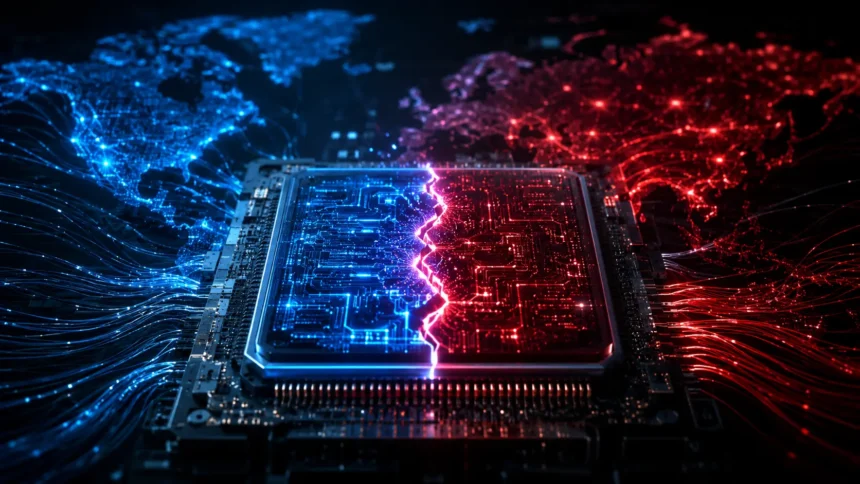
The global semiconductor supply chain is experiencing a permanent fracture. The digital world is splitting into two distinct ecosystems. One is tethered to Silicon Valley, utilizing Western architectures. The other revolves entirely around a self-sufficient, state-backed Eastern hardware network.
This digital fracture forces the Global South into a complex geopolitical corner. Developing digital economies across the Middle East, Southeast Asia, and Africa face a stark choice. Will they adopt the American tech stack or the Eastern alternative? Because the alternative architecture develops entirely free of US export controls, it presents a sanction-proof option for nations wary of Western leverage.
The New Table is Constructed
The ultimate irony of the semiconductor wars is now fully visible. In its aggressive attempt to restrict advanced processing power, the United States effectively catalyzed a parallel digital infrastructure. Nvidia’s financial success in the West masks a severe, structural vulnerability in the East.
The tech war is no longer about who sells the most chips on an open market. It is about who controls the underlying autonomous architecture of the future digital economy. Washington played its strongest card. In response, a completely new table was constructed.