

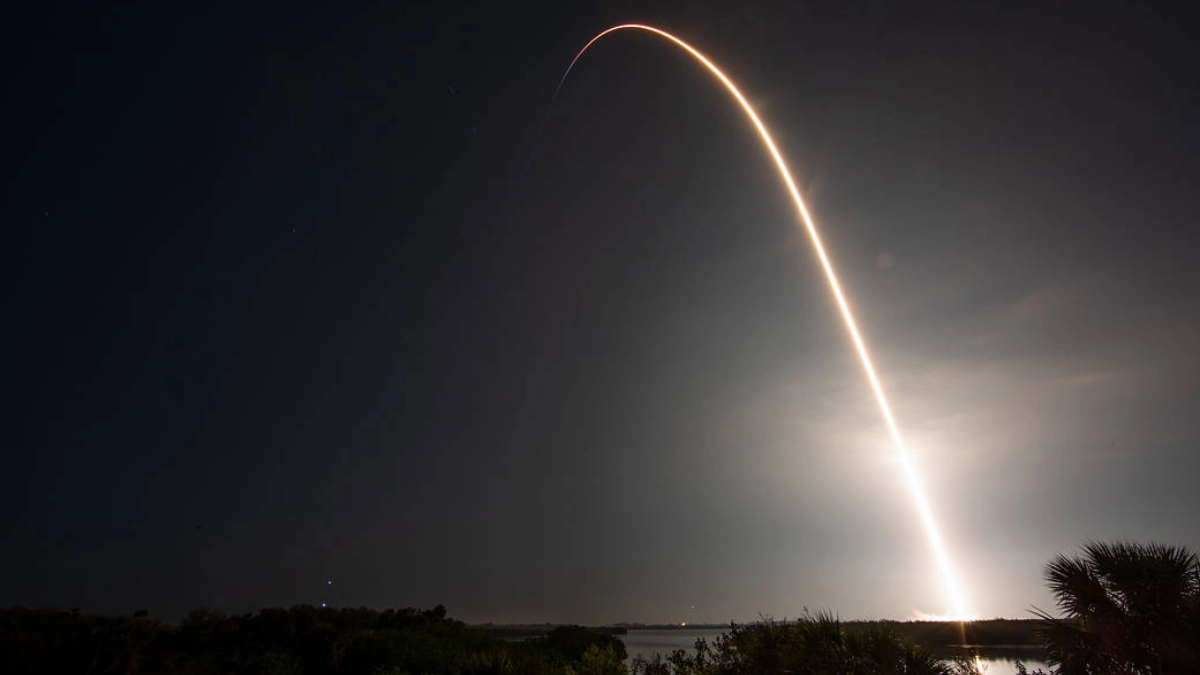
For two decades, Elon Musk built SpaceX on federal contracts, taxpayer-funded engineering programmes, and classified government launches worth approximately $22 billion in cumulative public expenditure. On June 12, 2026, he invited the public to finance the rest — raising $75 billion in the largest capital raise in the history of financial markets. The terms were not complicated: investors may purchase the risk, but they will not hold the vote. Musk retains 85.1% of all voting power.
Shares priced at $135 each on June 11, with 555 million Class A shares sold on the Nasdaq under the ticker SPCX. The raise surpasses Saudi Aramco’s 2019 record of $29.4 billion and places the company’s market value at approximately $1.77 trillion.
The Architecture of Three Businesses
SpaceX reported $18.7 billion in total revenue in 2025, built across three segments with sharply different financial profiles.
The Starlink satellite internet division generated $11.4 billion — 61% of total company revenue — at a segment EBITDA margin of 63%. Subscribers grew from 8.9 million at end-2025 to 10.3 million by Q1 2026, across 164 countries. No enterprise customer paying more than $750,000 a year has voluntarily cancelled since 2023. That retention record makes Starlink the sole financial engine of the consolidated group.
The Space segment generated $4.086 billion in revenue with a $657 million operating loss, reflecting Starship development costs exceeding $15 billion. The AI segment, added via the February 2026 all-stock acquisition of xAI, generated $3.2 billion in revenue against a $6.36 billion operating loss. Starlink’s margins are underwriting xAI’s capital requirements.
SpaceX posted a consolidated net loss of $4.9 billion in 2025. Adjusted EBITDA — a figure that strips out interest costs, taxes, and depreciation before those obligations are deducted — reached $6.58 billion. After those obligations are met, the company lost nearly $5 billion. The accumulated deficit on the balance sheet stands at $41.3 billion.
Public Wealth, Concentrated Returns
One-fifth of SpaceX’s 2025 revenue — approximately $3.7 billion — came from government agencies. A Space Force contract finalised in May 2026 added $6.45 billion for 28 national security launches through 2029. SpaceX controlled more than 80% of global mass to orbit in 2025.
Federal public wealth built the foundation beneath that dominance. NASA’s Commercial Crew programme transferred taxpayer-funded engineering validation and mission records to a private entity at terms that generated no ownership rights, no governance claims, and no dividends for the public. That public capital produced private returns. The investment profile was public. The reward structure was not.
That structure answers to one person.
Control Without Accountability
IPO investors received Class A shares carrying one vote each. Musk holds Class B shares carrying 10 votes each — a dual-class structure that legally separates economic ownership from governance authority, concentrating control in one hand while distributing financial risk across hundreds of thousands of investors. Per the S-1 filed with the SEC on May 20, 2026, Musk holds 93.6% of all Class B shares, giving him a combined voting power of 85.1%. SpaceX exempted itself from Nasdaq’s requirement to maintain a majority independent board. Musk holds the roles of CEO, CTO, and board chairman simultaneously.
A syndicate of 23 banks — led by Goldman Sachs, Morgan Stanley, JPMorgan Chase, Bank of America, and Citigroup — received approximately $500 million in fees to facilitate the transaction. Those fees were secured before a single SPCX share traded on the secondary market, collected regardless of how the stock performs after listing. Approximately 30% of IPO shares went to retail investors — a wider-than-standard distribution of financial exposure that came with no transfer of authority. Investors who collectively placed $75 billion hold no institutional mechanism to render account to management.
Starlink Without Oversight
The accountability gap carries operational consequences. Starlink’s 10.3 million subscribers depend on a communications layer whose coverage decisions rest with one executive — and that executive has already exercised that authority in an active conflict.
In September 2022, Musk declined to extend Starlink coverage near Russian-occupied Crimea to support a Ukrainian naval drone operation — documented in Walter Isaacson’s biography and subsequently corroborated by Reuters. SpaceX stated that coverage in the area had not been previously activated due to US sanctions on Russia; Ukrainian military sources stated the decision directly affected the operation’s outcome. The operative fact is not contested: a private supplier determined the operational boundaries of a front-line state. By early 2025, Ukraine had integrated at least 47,000 Starlink terminals into active operations, making coverage decisions a direct variable in how that conflict was waged.
The February 2026 xAI acquisition expanded the shareholder base to include Nvidia, Cisco Investments, Qatar Investment Authority, and Abu Dhabi’s MGX. Both Gulf sovereign wealth funds entered through the pre-IPO placement at a $1.25 trillion valuation — below the $1.77 trillion price paid by public investors on June 12. The pricing asymmetry concentrated preferential access with connected capital. The governance structure did not change.
The Riba Architecture
SpaceX enters public markets carrying $20.07 billion in riba-based debt. The structure of that debt is what the IPO prospectus does not emphasise: under riba-based financing, the lending institution receives a fixed return whether the borrowing enterprise produces value or destroys it. SpaceX lost $4.9 billion in 2025. The interest obligations ran regardless.
The primary instrument is a $20 billion bridge loan arranged by Goldman Sachs, carrying a 4.58% annual interest rate — approximately $916 million flowing annually to the lending institutions without a single rocket launched, a single satellite activated, or a single user connected in return. That is the defining feature of riba: return decoupled from productive activity, guaranteed to the capital holder independent of outcome. SpaceX is required to apply IPO proceeds to partial repayment within six months of the offering’s close — on a balance sheet that recorded a $4.9 billion net loss the prior year. The same five banks that arranged the bridge loan also led the IPO underwriting syndicate. They collected fees on both ends of the same transaction.
Underwriters hold a 30-day option to purchase a further 83.3 million shares at $135, which would lift total proceeds to approximately $86 billion. SpaceX holds 18,712 bitcoin, valued at $1.637 billion as of December 31, 2025.
SpaceX’s listing arrives alongside SEC filings from OpenAI and Anthropic, both targeting their own public offerings later in 2026. All three represent the consolidation of AI-adjacent infrastructure — satellite communications, language models, and data centres — into listed entities where capital ownership and operational authority have been structurally separated by design.
$75 billion changed hands on June 12. The infrastructure that federal contracts built, the network that 10 million users depend on, and the communications systems integrated into active military operations remain answerable — by law and by architecture — to one man.