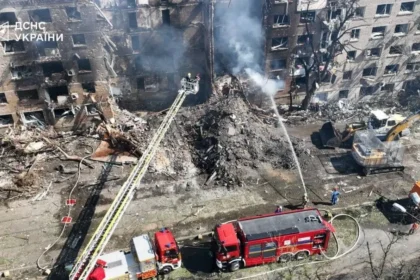


The airspace violation lasted exactly four minutes. On the night of May 28, a Russian explosive-laden drone breached Romanian territory and struck a 10-story residential building in the city of Galați. The impact ignited a fire on the roof, injured two civilians, and forced the rapid evacuation of 70 residents. This marks the first time since the war began that a populated urban center inside NATO borders has sustained a direct hit.
This was not an isolated navigation error but the outcome of a saturated airspace. The mechanism is straightforward: Moscow launched a massive wave of 232 unmanned aerial vehicles and one ballistic missile aimed at Ukraine’s southern logistics hubs. Ukrainian defenses successfully intercepted 217 of these incoming targets. However, one drone carrying a heavy warhead drifted 10 miles into Romania. For years, rural border towns have absorbed the occasional debris of this conflict. The strike on Galați represents a significant shift from empty fields to industrial population centers.
The Anatomy of a Stand-Down
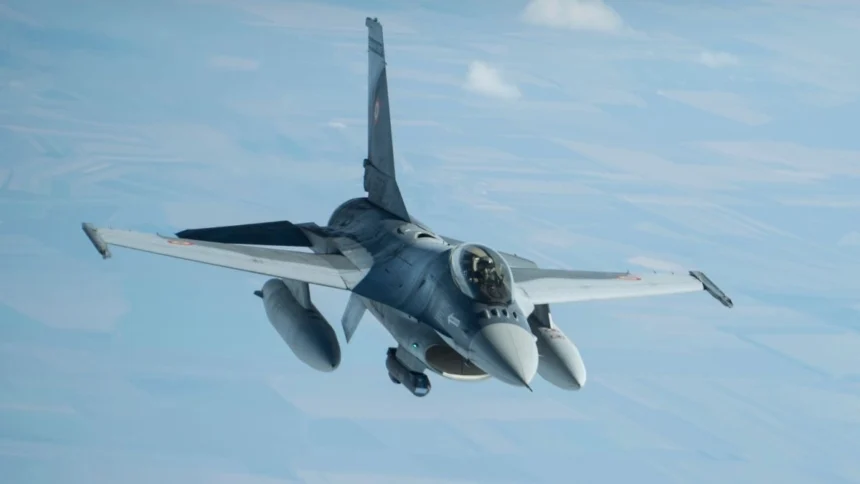
The data shows that the Romanian military had full awareness of the incoming threat. NATO AWACS aircraft monitored the regional airspace, and two F-16 fighter jets scrambled from the Fetești 86th Air Base alongside an IAR 330 helicopter. The fighter pilots flew with clear engagement authorization. Yet, they never fired upon the drone.
This restraint stems from a tactical trap inherent to modern warfare in urban environments. The Shahed-136 variant flew at an altitude below 100 meters at a speed of roughly 200 kilometers per hour. Shooting down a drone of that size directly over a city guarantees that its unexploded 40-to-50-kilogram warhead, along with burning fuel and structural shrapnel, will rain onto the civilians below. According to Romanian military officials, the kinetic interception itself would likely cause more collateral damage than allowing the platform to crash.
Shifting the Diplomatic Architecture
The inability to protect the airspace kinetically forced Bucharest to deploy its diplomatic arsenal. Following the incident, the Romanian government immediately closed the Russian consulate in the strategic Black Sea port of Constanța and expelled Consul Andrei Kosilin. This decision effectively blinds a critical intelligence node overlooking the primary maritime logistics corridor linking Ukraine to global markets.
Moscow responded with a familiar strategy of denial. Russian President Vladimir Putin demanded the drone wreckage for an objective investigation, suggesting the origins of the weapon were unproven. Simultaneously, NATO Secretary General Mark Rutte acknowledged the severity of the event, stating clearly that the effects of the conflict do not stop at the border. Rather than pushing for a direct military confrontation under Article 5, Romania is applying this event as diplomatic pressure to demand the rapid transfer of advanced anti-drone technologies from its allies.
The Cost of Defending the Sky
The question is not whether NATO possesses air defense systems — it is how those systems are scaled against asymmetric threats. Firing multi-million-dollar interceptor missiles at drones that cost a fraction of that price is mathematically unsustainable over a long campaign. This economic reality is accelerating the deployment of systems like MEROPS. The platform launches small, autonomous interceptor drones designed to physically collide with incoming targets without relying on GPS.
At approximately $15,000 per interceptor, the economics finally align against swarm tactics. However, even this technology struggles with the same fundamental constraint identified in Galați. Deploying kinetic interceptors over densely populated areas remains highly dangerous for the people below. A viable defense architecture requires neutralizing these platforms at the point of entry, long before they reach urban centers.
European governments are now attempting to build a multi-layered “Drone Wall” stretching 4,000 kilometers from Finland down to Romania. Until that integrated sensor network and response infrastructure is fully operational, borders remain porous to these low-altitude incursions. The impact in Galați confirms that modern red lines are no longer crossed with invading armies. They are erased slowly, one drifting weapon at a time.