


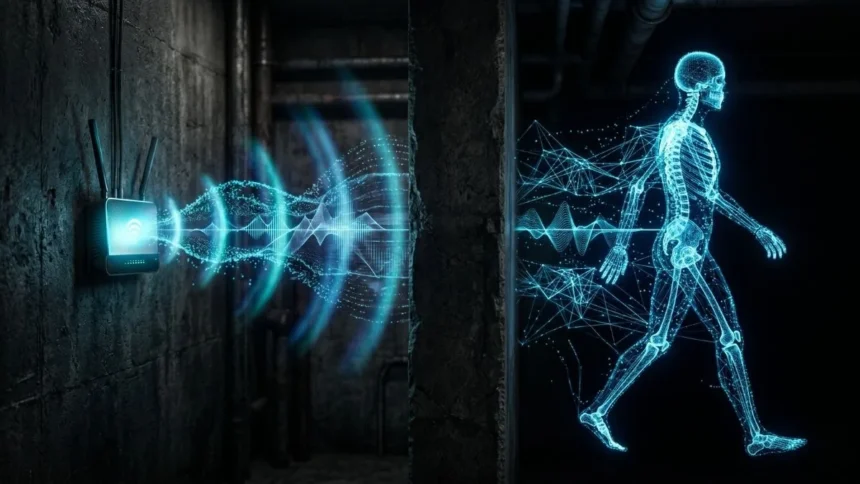
In a secure research facility in Germany, 197 volunteers walked through a standard wireless signal zone. They carried no tracking devices, wore no sensors, and stood before no cameras. Yet, as they moved, every shift in their gait, every millimetric expansion of their chest, and their precise skeletal structures were being logged with terrifying precision. By the end of the experiment, researchers had synthesized a biometric identification system that identified individuals with 99.5% accuracy using nothing but the ambient radio waves already floating in the air.
The routers sitting in your living room and the access points in your local café are no longer just tools for high-speed data. They have been transformed into a global, invisible, and persistent sensor network. This shift from communication to “WLAN Sensing” means that the physical environment is now a searchable database. The walls that once provided privacy now act as translucent filters for invisible sensing technologies that require no light, no line-of-sight, and no consent.
How did a protocol designed for the internet become the ultimate tool for domestic surveillance, and why is the law silent as your router maps your heartbeat?
The Anatomy of a Radio Shadow
To understand how a router “sees,” one must first acknowledge that the human body is effectively a dynamic water tower. Roughly sixty to seventy percent of our mass is water, which acts as a powerful dielectric surface that absorbs and reflects electromagnetic energy. When you move through a room, you do not just walk; you modulate the air. You leave a wake of multipath fading and Doppler shifts that ripple through the 2.4 GHz and 5 GHz bands.
Standard communication systems are designed to ignore this “noise” to maintain a stable connection. However, modern sensing architectures build a digital twin of the environment by analyzing these very distortions. The wavelength of a 5 GHz signal is approximately six centimeters, a scale perfectly suited to track the coarse movements of a human torso. As we move toward higher frequencies, the resolution tightens, allowing systems to monitor milimetric tremors or the rhythm of a breathing cycle from behind a concrete wall.
The Unencrypted Human Signature
The technical development of this surveillance has moved from the laboratory to the street through a mechanism known as Beamforming Feedback Information (BFI). In earlier iterations, researchers relied on Channel State Information (CSI), which required “hacking” a device’s firmware to extract data. CSI was a high-resolution map, but its hardware limitations made it difficult to deploy at scale.
BFI changed the game by being a functional necessity of the WiFi 5 standard and beyond. To focus a signal on your phone, a router must constantly “ping” the environment to understand where obstacles—like your body—are located. The client device then sends back a steering matrix to the router to correct the signal. The data shows that these BFI packets are transmitted in plaintext format across the airwaves. Anyone with a $200 Software Defined Radio (SDR) can passively intercept these packets without ever joining the network or breaking a single password.
Deep Learning and the Skeletal Reconstruction
Raw radio data is a chaotic stream of numbers that means nothing to the human eye. To turn these fluctuations into dense body surfaces, researchers use a “Teacher-Student” neural network architecture. During the training phase, an optical camera (the Teacher) records a person while WiFi sensors (the Student) simultaneously log the radio distortions. The AI learns to correlate specific skeletal data with specific signal patterns.
Once the training is complete, the camera is removed. The Student—the AI—can now produce real-time animations of a person’s movements through walls, solely by processing the WiFi interference. Projects like MIT’s RF-Pose first demonstrated this by mapping 14 key joint points. By 2023, Carnegie Mellon’s DensePose From WiFi reached a point where it could generate 3D surface maps of multiple people in total darkness using off-the-shelf TP-Link routers.
The 802.11bf Mandate: Default Surveillance
While these experiments were once confined to elite universities, they are now being codified into the very fabric of global technology. In September 2025, the IEEE 802.11bf-2025 standard was officially released. This amendment formally transitions WiFi from a communication tool into a radar and sensor platform. It introduces “Sensing by Proxy,” a procedure that allows one device to listen to the signal exchange between two others to perform radar tracking on the surrounding environment.
What this means for the average professional is straightforward: every Wi-Fi 7 or Wi-Fi 8 device you purchase will have embedded sensors capable of mapping your physical presence by default. The industry presents this as a “privacy-preserving” alternative to cameras because it does not capture facial features. However, the KASTEL experiment proved this to be a fallacy. Your walking rhythm and bone density synthesize a biometric fingerprint that is as unique as a face—and far harder to hide.
The Legal Vacuum and the Privacy Paradox
The speed of this hardware deployment has left international data protection authorities in a state of paralysis. Under the General Data Protection Regulation (GDPR), biometric data is classified as “Special Category Data,” requiring explicit and written consent for processing. Yet, how can a pedestrian walking past a café give “meaningful consent” to the radio waves that bounce off their chest and extract their identity from a distance?
Current laws are built on the assumption of active interaction—using a website, connecting to a network, or standing before a visible camera. WiFi sensing requires none of these. Because BFI packets are unencrypted and floating in public space, capturing them does not technically constitute unauthorized system access in many jurisdictions. We are entering an era where our biological data is being broadcast dozens of times per second to any passive listener with a laptop.
A Definitive Thought on the Invisible Grid
Technology is never neutral; it is a reflection of the priorities of its builders. The decision to leave BFI packets unencrypted while standardizing WLAN Sensing in IEEE 802.11bf is a structural choice that favors surveillance over the individual. While the beneficial applications of this tech—such as monitoring elderly patients for falls—are real, they are being used to justify a mechanism that can map an entire population without their knowledge.
From an analytical perspective, the “no-camera” defense is a semantic loophole designed to bypass social friction. A sensor that can determine your heart rate, your identity, and your 3D posture through a wall is, by any honest definition, a camera. Unless international lawmakers mandate encryption for sensing packets at the hardware level, the very air in our homes will become a permanent, unblinking witness to our private lives.
The focal point of truth remains clear: the convenience of a connected world is being traded for a level of physical transparency that no society has ever consented to.