

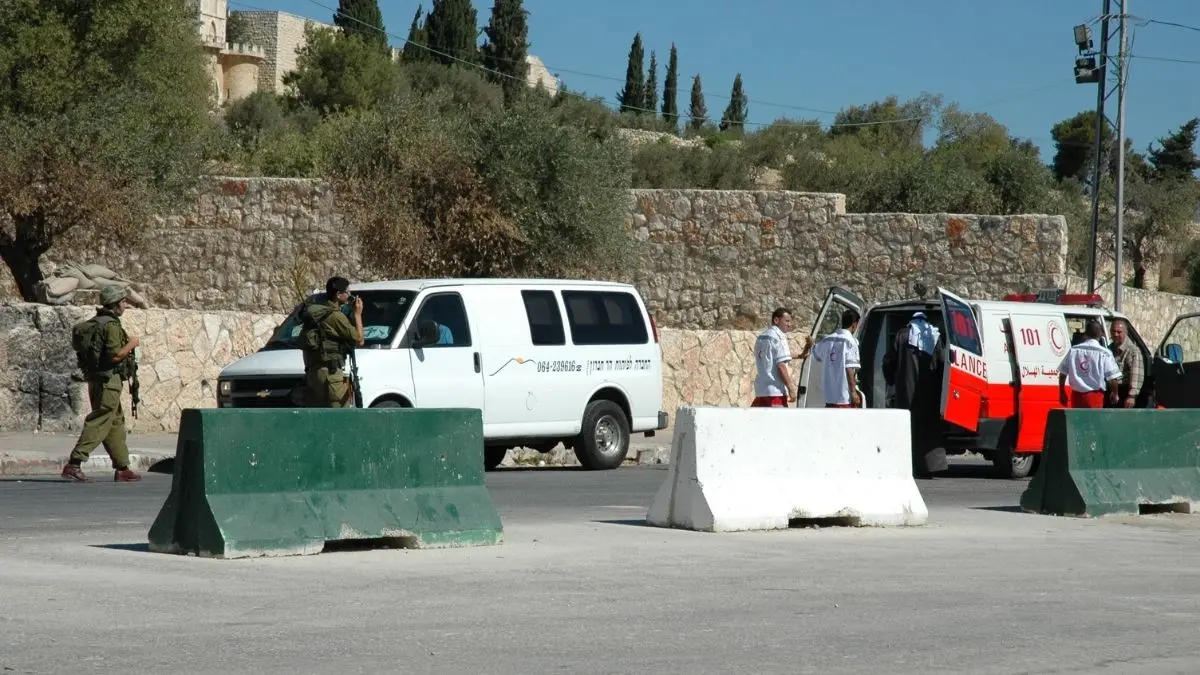
The car could not move. It was Sunday evening at the entrance to Deir Ammar, a village west of Ramallah, and Israeli soldiers were holding the vehicle at the checkpoint. Inside was a four-month-old boy his family was rushing to a hospital.
His name was Ahmad Ma’rouf Zaid. The soldiers kept the family waiting more than an hour, Palestinian officials say, and fired tear gas canisters toward the Palestinians and vehicles near the crossing. By the time doctors at the Istishari Arab Hospital reached the child, they could only confirm that he had died.
An hour. One closed road. A baby who needed to be somewhere else.
What happened at that barrier still needs a full and transparent investigation. But the shape of the problem is already clear. Ahmad did not die only because of one gate on one evening — though that evening demands its own answer. He died on a single thread of a system that sorts, every day, which Palestinian passes and which one waits.
Last December, UN monitors counted 925 of those barriers across the occupied West Bank: checkpoints, road gates, roadblocks, earthmounds, and closures. It was the highest total in twenty years of record-keeping, and 43 percent above the two-decade average. Together they control the movement of 3.4 million people, and checkpoints and gates alone make up close to 60 percent of them.
The Security Argument, and Its Limit
Israel says these barriers are about security, and that claim belongs in the record. The West Bank has seen armed attacks, raids, and military operations, and Israeli authorities point to them to justify tighter control over who moves and when.
Occupation law accepts the first part and refuses the blank check. The International Committee of the Red Cross is direct about it: an occupying power may take security measures, but those measures stay bound by international humanitarian law and human rights law. Power over a territory comes with a duty toward the people living under it, and getting a dying child to a hospital sits near the heart of that duty.
At a barrier, that duty is measured in minutes. A queue, a search, a decision to hold a car instead of waving it through — any of them can close the gap between a patient and the treatment waiting on the other side.
A Pattern, Not an Accident
Ahmad’s hour was not a rare malfunction. For Palestinians who need serious medical care, the wait is often built into the route.
Much specialized treatment sits in hospitals in East Jerusalem and Israel, and reaching them requires an Israeli permit. In 2025, 36 percent of the 87,427 permit requests Palestinians filed for that care were denied or left unanswered. In 2022 the figure was 18 percent. In three years, the odds of simply being allowed to reach a specialist have roughly doubled against the patient.
The barriers reach the ambulances too. The World Health Organization recorded 233 attacks on health care in the West Bank in 2025, and in 84 percent of them the harm was obstructed access: checkpoint delays, searches, and crews stopped on their way to a call.
The pressure did not ease this year. By the end of May, humanitarian partners had logged 230 access incidents across the West Bank, OCHA reported in June, with checkpoints and closures the most common obstacle. In Nablus, Hebron, Jericho, Qalqilya, and Ramallah, ambulance teams were rerouted — and in some cases left their vehicles and carried patients the rest of the way on foot.
The longer count is heavier. Between October 2023 and the end of May 2026, WHO logged 987 attacks on health care in the West Bank: 39 people dead, 201 injured, 673 ambulances affected. None of these numbers explain Ahmad’s specific hour, but every one of them describes the road it happened on.
The Question Deir Ammar Leaves
Strip away the vocabulary of permits and obstacles, and a plain question remains. Can a system that puts civilian movement under military control be trusted to let a dying infant through in time?
The record is not reassuring. OCHA and WHO have documented the delays, the closed gates, and the stopped ambulances, year after year, in the same governorates, with the same results.
That is why one checkpoint near Ramallah reaches past one family. Deir Ammar needs its own answer, and it lands on a map humanitarian agencies filled in long ago.
Beyond One Road Near Ramallah
Criterion Post has walked this ground before — the arrests, the raids, the movement restrictions in 23,000 Arrests Since 2023: Israel’s West Bank Raids Continue. Ahmad’s case arrives from a quieter direction: the road to a hospital.
The occupied West Bank is not held only through raids and colonial expansion. It is also held in smaller pieces — which road stays open, which car is stopped, how long a family is made to wait, and whether an emergency is recognized before the clock runs out.
For a four-month-old at the entrance to Deir Ammar, the clock ran out at a checkpoint, with a hospital somewhere ahead and an hour he did not have. What happened to him needs an answer. The road that kept him waiting needs one too.