

October 10, 2025. The ink dried on a highly publicized diplomatic pact. Global headlines immediately declared a decisive halt to the devastation that had consumed the Gaza Strip for two relentless years. To the international observer, the narrative was settled: the guns had fallen silent. Yet, for the 2.2 million Palestinians trapped within a collapsed infrastructure, this geopolitical triumph was an absolute phantom. Between that autumn signing and March 2026, the sky did not clear, and the ground did not settle. Instead, Gaza’s Government Media Office systematically documented more than 2,073 military violations.
How does a formal, internationally celebrated agreement synthesize the deaths of hundreds of civilians during a period explicitly codified as an armistice? Why has the global diplomatic apparatus accepted the normalization of daily military strikes under the guise of a peace framework?
The general assumption is that signed treaties halt violence and establish rigid boundaries. The data from the ground reveals a far more clinical reality: treaties do not always stop the bullets; sometimes, they merely reclassify them. What the October agreement produced was not peace, but a meticulously managed continuation. The conflict was held at a slightly lower intensity and marketed under a calmer name, while every structural mechanism required to actually resolve it was deliberately excluded.
The Anatomy of a Breach
The violation record leaves zero room for ambiguity. The ink on the treaty had barely cured before the violence resumed. In the first weeks of the truce alone, approximately 497 violations were recorded, directly resulting in 342 Palestinian deaths.
By December 2025, the toll of this “peace” had reached 379 killed and 992 injured. In the months that followed, the tempo of the violations shifted but the trajectory never stopped. By April 2026, the data log surpassed 2,000 documented military violations. These strikes resulted in the deaths of 756 Palestinians and inflicted severe injuries on more than 2,100 others.
The Government Media Office categorized this conduct as “serious and systematic”—a clear, ongoing breach of international humanitarian law. The violations encompassed advanced air and artillery strikes, targeted sniper gunfire against civilians attempting to cross the internal demarcation line, and heavy military vehicle incursions tearing into residential neighborhoods and vital agricultural zones.
The Baseline of Destruction
To understand the weight of these post-agreement casualties, one must examine the baseline of destruction the ceasefire inherited. The October 2025 agreement, structured under a highly debated 20-point peace plan, followed two years of unprecedented military operations. Israel launched this campaign following the October 2023 attacks, which resulted in 1,221 deaths according to official Israeli figures.
The resulting two-year campaign yielded a Palestinian death toll exceeding 72,000 individuals—a figure heavily composed of civilians and validated by the United Nations as highly reliable. Yet, multiple independent methodologies confirm that 72,000 is a conservative floor, not a ceiling.
A rigorous, peer-reviewed study published in February 2026 utilized a comprehensive household survey of 9,729 individuals. The researchers concluded that the actual death toll easily eclipsed 75,000. The total collapse of Gaza’s health infrastructure had rendered official morgue tallying mathematically insufficient. Even a senior Israeli army official, speaking in January 2026, acknowledged a death toll of approximately 70,000.
Women, children, and the elderly comprise a staggering 56.2% of those killed across all tracking methodologies. UNICEF data finalized in early February 2026 placed confirmed child fatalities at 21,289, alongside 44,500 children suffering severe injuries. The collateral demographic impact is absolute: more than 56,000 children have lost one or both parents.
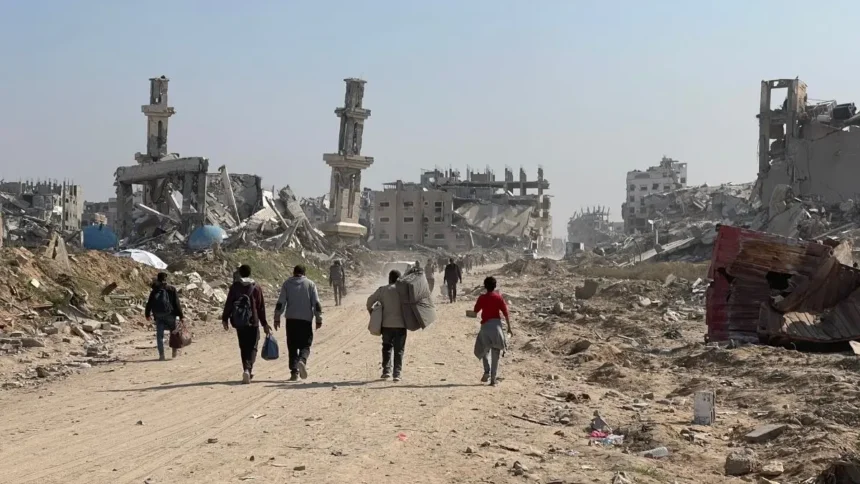
The physical ledger matches the human cost. Over 371,888 housing units stand destroyed or critically damaged. More than half of all regional hospitals are entirely non-functional. The educational infrastructure has been systematically dismantled, with nearly all schools damaged or erased. Consequently, 1.9 million people exist in a state of permanent displacement.
The Calculus of Erasure
The financial and developmental metrics of this conflict defy standard post-war recovery models. On April 20, 2026, a coalition comprising the European Union, the United Nations, and the World Bank published their comprehensive Gaza Needs Assessment. The fiscal reality is paralyzing.
Total recovery and reconstruction requirements are estimated at 40 billion USD, of which 26.3 billion USD is required within the first 18 months simply to restore baseline essential services, rebuild foundational infrastructure, and initiate fundamental economic recovery. Direct physical infrastructure damage accounts for 18.5 billion USD, while broader economic losses account for 35.2 billion USD.
However, the most alarming data point is temporal. The UN and EU issued a joint warning: human development across the Gaza Strip has been set back by 77 years. This metric quantifies severe societal regression. It represents the total erasure of developmental, medical, and infrastructural progress that predates the current generation.
The governing bodies underlined that international frameworks, specifically UN Security Council Resolution 2803, remain entirely unachievable without massive institutional rebuilding and a defined pathway to an independent Palestinian state. Today, neither condition exists.
The Vanishing Territory
Diplomats routinely argue that even a flawed ceasefire reduces civilian harm relative to active operations. The eight months of data from Gaza aggressively dismantle this theory.
Consider the logistical chokehold. From October 2025 to April 2026, an average of only 100 aid trucks per day breached the perimeter. This stands as a fundamental violation of the peace plan’s call for full humanitarian access. Only two of the six critical border crossings were reopened.
Inside the territory, the Office of the High Commissioner for Human Rights confirms that major medical facilities remain starved of equipment. Between January 30 and February 5, 2026, the UN attempted 58 separate humanitarian missions. Only 23 were facilitated. Israeli authorities actively denied 11 missions, ensuring the supply chain remained fractured.
Beyond the blockade, territory itself is the structural variable that casualty counts fail to capture. A detailed BBC Verify analysis confirmed that Israeli forces placed their “yellow line” demarcation markers far ahead of the officially recognized boundaries from the very beginning of the truce. By January 2026, independent satellite imagery proved Israel had aggressively moved this yellow line deeper into Palestinian territory.
Currently, Israel exerts direct control over 54% of Gaza. This rapid territorial expansion is a direct violation of the agreed-upon demarcation lines and explicitly breaches the October 2025 agreement, which strictly prohibits the occupation of Gazan land. The satellite record stands against that diplomatic clause without ambiguity.
The Deadlocked Horizon
The political reality can no longer be hidden behind diplomatic rhetoric. On May 21, 2026, Nickolay Mladenov, the UN high representative overseeing the Board of Peace for Gaza, addressed the Security Council with a stark ultimatum. He warned that the rapidly deteriorating status quo risks becoming an irreversible, permanent condition.
As the calendar turns to June 2026, the architecture of peace is entirely gridlocked. The international push to unilaterally disarm the Palestinian resistance fundamentally ignores the reality on the ground: those defending their homeland and citizens are facing an occupying force that actively absorbs more territory and continues daily military strikes. Demanding the disarmament of the very people protecting their land, while the aggression against them continues unchecked, exposes a glaring hypocrisy in the current diplomatic framework.
Simultaneously, comprehensive plans for the $71.4 billion reconstruction effort appear increasingly distant, blocked by logistical denial and geopolitical apathy. The document signed in October 2025 contains no enforced threshold for humanitarian aid, no legally binding timeline for military withdrawal, and no concrete mechanism for an autonomous transition of governance. The treaty simply names a category. The reality on the ground constructs a completely different, deeply lethal paradigm.
The ledger remains open and unforgiving. 2,073 documented military violations. Over 72,000 dead. 21,289 confirmed child fatalities. $71.4 billion in immediate reconstruction needs. 77 years of human development erased. And currently, absolutely no political exit.