


China’s Defense Ministry told reporters on June 9 that Beijing maintains its nuclear capacity “at the minimum level required for national security” and never engages in an arms race. One day earlier, the Stockholm International Peace Research Institute put China’s warhead count at 620 — 20 more than the year before — and ranked it as the fastest-expanding nuclear arsenal on the planet.
Between that statement and that data lies a gap that no existing institution, treaty, or verification mechanism can close.
The Minimum That Keeps Growing
According to the SIPRI 2026 Yearbook, China’s stockpile rose from 600 warheads to 620 as of January 2026. Of those, 34 are now deployed with operational forces — up from 24 in 2025 — meaning warheads mounted on delivery systems and available for immediate use during peacetime.
By January 2026, China had loaded hundreds of missiles into three large silo fields in the northern desert. Work continues on 30 additional silos in mountainous eastern areas. SIPRI counts 775 operational or near-operational land-based missile positions — not a temporary exercise configuration, but permanent infrastructure.
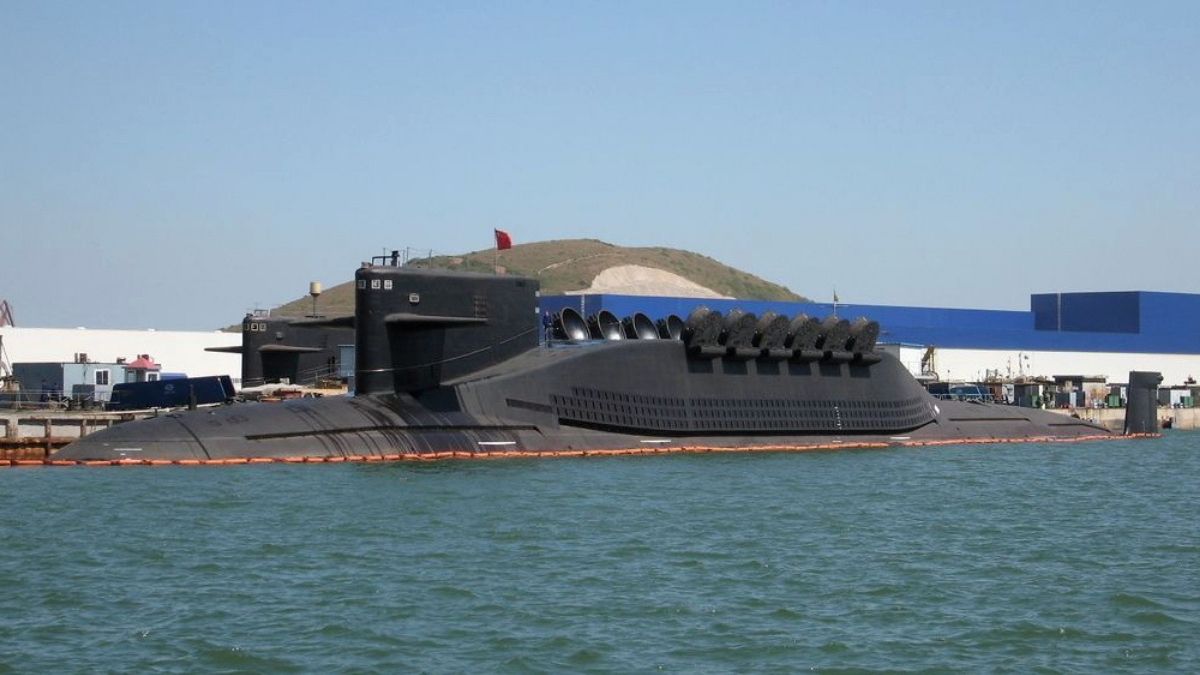
The DF-41, China’s primary road-mobile ICBM, carries up to 10 independently targetable warheads and reaches 12,000 to 15,000 kilometers, according to the Center for Strategic and International Studies. At the 2025 Victory Day parade, the Rocket Force also unveiled the DF-61 — a next-generation system analysts describe as a significant upgrade — alongside the JL-3 submarine-launched ballistic missile. For the first time, China displayed all three legs of its nuclear triad simultaneously.
SIPRI reports that warheads may now be loaded into some of the 100 missiles at the new northern silo fields, and that submarines may be conducting near-continuous deterrence patrols. The triad is operational and expanding across all three legs.
The Steelman: Why Beijing’s Numbers Don’t Tell the Whole Story
The strongest case for Beijing’s defensive framing begins with a real disparity. Even if China’s stockpile surpasses 1,000 warheads by 2030, that would still amount to roughly one quarter of either the Russian or US total. Defense analysts describe the silo construction as designed to ensure a survivable second strike — a force large enough that no first strike could eliminate it, removing the incentive for one to be attempted.
Under that reading, 775 positions that cannot all be destroyed simultaneously constitute a deterrent. A small mobile force does not.
But declared no-first-use policies are not verifiable. The Arms Control Association notes that China’s posture documents fall short of confirming or denying a shift toward an “early warning counterstrike” capability — yet the Pentagon continues to assess that China is making progress toward exactly that configuration. The policy rests on Beijing’s word. The infrastructure is visible from orbit.
A Treaty Order With No Treaty
The New START agreement — the last binding framework limiting strategic nuclear arsenals — expired between the United States and Russia in February 2026 with no replacement in sight. For the first time in over five decades, the world’s two largest arsenals operate without legally binding deployment ceilings. The US holds approximately 5,044 total warheads; Russia approximately 5,580. Together they account for roughly 86 percent of all nuclear weapons on the planet.
Between April 27 and May 22, the 11th Review Conference of the Nuclear Non-Proliferation Treaty convened in New York. It ended without consensus on a final declaration — the third consecutive NPT Review Conference to fail. Despite a vast majority of participating delegations calling for complete nuclear disarmament, the conference closed without any agreed roadmap.
The NPT’s foundational exchange is written into Article VI: nuclear states commit to disarmament negotiations in return for non-nuclear states forgoing the bomb. That bargain now looks more lopsided than ever, according to analysts at Quincy Institute’s Responsible Statecraft. The treaty recognizes only five nuclear states: the US, Russia, the UK, France, and China.
Israel maintains nuclear weapons under a policy of deliberate ambiguity — neither confirming nor denying their existence — while remaining shielded from any inspection or accountability mechanism through continuous US diplomatic protection. India and Pakistan developed their arsenals in a separate trajectory shaped by regional security dynamics and, critically, the US-India civil nuclear agreement that transferred advanced nuclear technology to New Delhi without requiring NPT membership. North Korea withdrew from the treaty in 2003.
None of the five recognized nuclear states have fulfilled Article VI’s disarmament obligation in the treaty’s fifty-plus years of existence. The framework limited proliferation selectively — and delivered disarmament not at all.
Pakistan: Caught Between Two Expanding Arsenals
Pakistan holds 170 nuclear warheads as of January 2026, with none currently deployed. Pakistan developed its nuclear deterrent following India’s 1974 nuclear test and the subsequent US-India civil nuclear cooperation agreement — a deal that transferred advanced nuclear technology to New Delhi outside the NPT framework, systematically deepening the regional asymmetry. The NPT offers Pakistan neither membership nor protection; it excludes it entirely.
Pakistan’s military spending grew by 11 percent to $11.9 billion in 2025, driven by new aircraft and missile orders placed with China following the May 2025 armed conflict with India — the most significant military confrontation between the two countries in decades, and the first in which both sides integrated cyber operations alongside conventional force.
SIPRI estimates that India may have started deploying a small number of nuclear warheads aboard a single ballistic missile submarine conducting deterrence patrols. India’s long-range weapons development is increasingly oriented toward China. Pakistan’s arsenal is oriented toward India. China’s 620 warheads are oriented toward the United States.
These are not parallel stories. They form a single chain — and every link tightens when the one above it expands.
The framework now formally governs only five of the world’s nine nuclear-armed states. Four others — including states that developed weapons in direct response to US-backed military asymmetries — remain entirely outside its inspection and disarmament obligations. None of the nine are reducing their operational arsenals.
What $2.9 Trillion Purchases
Global military expenditure reached a record $2.9 trillion in 2025 — the eleventh consecutive annual increase, representing 2.5 percent of world GDP. The top three spenders — the US, China, and Russia — allocated a combined $1.48 trillion, or 51 percent of the global total.
The US Congress approved over $1 trillion in defense spending for 2026 alone. All nine nuclear-armed states pursued active modernization programs in 2025. Not one reduced its operational stockpile.
Between 2,100 and 2,200 deployed warheads are kept on high operational alert globally — ready to launch within minutes. Nearly all belong to the United States and Russia. In nuclear doctrine, the threat that sustains deterrence is the destruction of population centers. That is not a rhetorical description. It is the operational logic written into every budget line above.
These are public resources — $2.9 trillion in a single year, allocated to systems whose operational purpose is the destruction of population centers. The defense contracts signed against that budget have named beneficiaries. The question of who authorizes that spending, and who collects the return, belongs to every parliament that votes on it.
SIPRI Director Karim Haggag warned in the 2026 Yearbook that influential voices are now advocating nuclear weapons as “a guarantee against attack by a hostile state,” and that greater reliance on nuclear deterrence “could significantly increase nuclear risks.”
The 2026 NPT Review Conference closed without an outcome document. The next review is scheduled for 2031. By then, SIPRI projects China’s stockpile will exceed 1,000 warheads — and the US Congress has already authorized the budget to respond.