

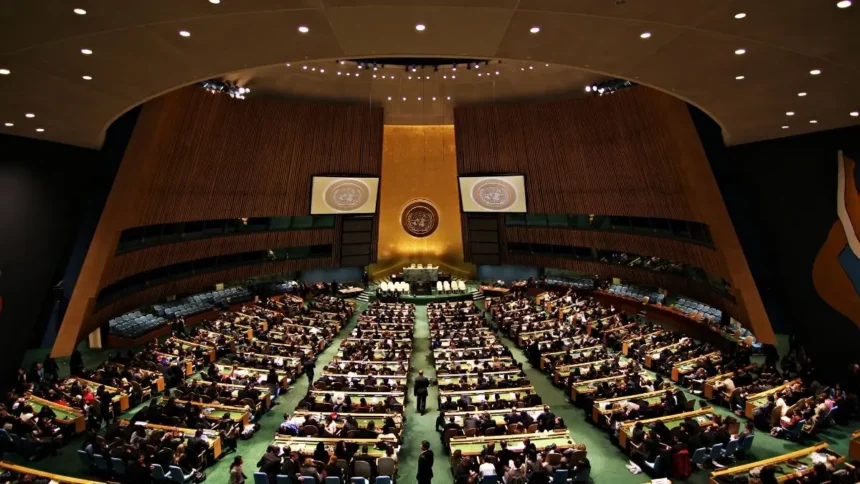
On June 3, 2026, the United Nations General Assembly in New York conducted a vote to elect five non-permanent members to the Security Council for the 2027-2028 term. Out of 193 member states, a staggering 191 cast secret ballots, locking the winning threshold at a rigid 127 votes. When the ballots were tallied, Austria, Portugal, Kyrgyzstan, Trinidad and Tobago, and Zimbabwe secured the seats, replacing the outgoing bloc of Denmark, Greece, Pakistan, Panama, and Somalia.
To the general public, this event is often dismissed as a mundane bureaucratic rotation. It is anything but. This specific vote operates as a massive, highly sensitive geopolitical seismograph. Why did a European financial heavyweight fail to secure a seat, while a landlocked Central Asian republic absolutely dismantled a heavily backed Indo-Pacific candidate? The data reveals a brutal, undeniable realignment of global power dynamics, proving that the non-aligned world is actively neutralizing traditional hegemonic control.
The Diplomatic Earthquake in Europe
The most intense shockwave of the day struck the Western European and Others Group (WEOG). Three nations competed for two available seats. Germany, an economic powerhouse that had previously served six terms on the Council, suffered a humiliating first-round elimination, securing only 104 votes. Portugal and Austria easily claimed the seats with 134 and 131 votes, respectively.
The raw numbers highlight a severe political bill handed directly to Berlin by the Global South. While German officials publicly attributed the loss to their rigid stance on the Ukraine conflict, the structural breaking point involved Berlin’s Middle East policies. Germany’s continued diplomatic shielding and arms supplies to Israel during the Gaza conflict generated immense, unyielding backlash across Arab and African states. Germany’s 2024 abstention regarding Palestine’s full UN membership was carefully noted by global diplomats, directly translating into organized protest votes favoring Austria and Portugal.
Unlike Germany’s heavy, polarizing geopolitical baggage, the victors presented highly flexible, dialogue-driven platforms. Portugal utilized its extensive linguistic and historical ties across Africa and South America, prioritizing conflict prevention and climate security. Austria weaponized its historical neutrality, framing itself as a reliable, non-combative mediator. The European voice within the Elected 10 (E10) will now pivot sharply away from aggressive sanction demands, focusing instead on early warning systems and strict international law adherence.
The Eurasian Heartland Defeats the Indo-Pacific Strategy
The most fiercely contested battleground unfolded within the Asia-Pacific group. For three agonizing rounds, neither Kyrgyzstan nor the Philippines could break the two-thirds threshold. In the decisive fourth round, Kyrgyzstan achieved an undeniable 142-49 triumph.
This was not a simple bilateral contest. It was a structural clash of two colossal global visions: the maritime Indo-Pacific strategy versus the continental integration of the Eurasian Heartland. The Philippines stands as a central pillar of maritime deterrence in the South China Sea, attempting to carry rule-based maritime narratives to the Security Council. Despite robust backing from Washington and key ASEAN neighbors, securing a meager 49 votes exposes the hard limits of the Indo-Pacific narrative among non-aligned nations.
Conversely, Kyrgyzstan executed a flawless, multi-vector diplomatic offensive. Backed by Central Asian neighbors and the Organization of Turkic States, Bishkek aggressively expanded its lobbying footprint. Crucially, the Organization of Islamic Cooperation (OIC) issued a formal resolution urging its 57 members to back the Kyrgyz bid, a call largely honored by the Islamic world and the African continent. Kyrgyz diplomacy also successfully breached Western capitals, neutralizing the Philippine monopoly on strategic dialogue through high-level meetings in Washington mere days before the vote. By championing the rights of landlocked, developing nations, Kyrgyzstan secured its first-ever seat.
The Unified Voice of the Global South
Running unopposed for the African Group’s vacant seat, Zimbabwe captured a staggering 182 votes. Having navigated years of targeted economic and political sanctions, Harare enters the Council with a doctrine explicitly opposing the weaponization of human rights frameworks by major powers as pretexts for intervention. Their presence practically guarantees severe friction against any attempts to push stringent sanction resolutions regarding African crises. However, internal domestic crackdowns on civil society provide Western states a diplomatic opening to pressure Harare on constitutional boundaries while they sit on the global security stage.
In the Latin American and Caribbean Group (GRULAC), Trinidad and Tobago swept into office with 181 votes. The nation intends to forcefully highlight the illicit trafficking of small arms and light weapons (SALW), alongside asymmetric threats like artificial intelligence and the existential risks climate change poses to island nations.
Dismantling the “Irrelevance” Myth
Western institutional projections routinely assume that temporary members are functionally useless due to the permanent veto paralysis of the P5 (US, UK, France, Russia, China). They argue that regardless of who sits in the E10 seats, major conflict resolutions will inevitably crash into a veto, leaving the system entirely controlled by the traditional powers.
The raw mechanics of the Council completely dismantle this assumption. To pass any resolution, a minimum of nine affirmative votes is required. A unified block of anti-interventionist E10 members can effortlessly deny this minimum threshold, effectively killing Western drafts before they even reach the veto stage. Furthermore, the April 2022 “Veto Initiative” mandates that any P5 nation exercising a veto must justify its decision before the entire 193-member General Assembly within ten days. The new E10 possesses the numerical leverage and the diplomatic agility to utilize this mechanism as a relentless moral pressure block. The 2027-2028 Security Council is not a venue for business as usual; it is poised to become the exact arena where the Global South will actively rewrite the parameters of international crisis management.