

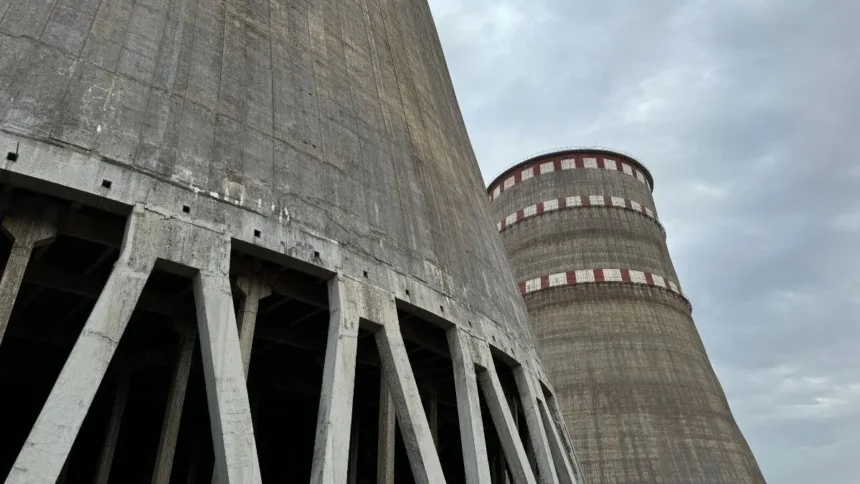
On May 30, 2026, a single physical impact at the Zaporizhzhia Nuclear Power Plant exposed a vulnerability that billions of dollars in electronic defenses could not prevent. A physical kamikaze drone struck the metal access hatch of the Unit 6 turbine building, breaching the primary security perimeter for the first time since April 2024.
While automated sensors reported stable radiation levels, the actual damage was systemic rather than structural. The strike proved that the invisible electromagnetic walls built to protect critical infrastructure are entirely obsolete against wired guidance. This development redefines the intersection of industrial security and modern asymmetric combat.
How did a low-cost, physical modification allow a basic drone to completely blind the most sophisticated defense grid in the region?
The answer lies in the technical development of the hardware found at the scene. For years, defense planners assumed that dominant signal-jamming grids and electronic warfare arrays could drop any unauthorized aircraft from the sky. The physical evidence recovered on the morning of May 31 by the on-site team shattered this assumption entirely.
Scattered across the ground beneath the damaged turbine hall were burnt fragments of physical glass fibers. This drone did not communicate via radio waves or satellite tracking signals; it was physically tethered to its operator by an un-jammable wire. By discarding wireless transmission, the platform bypassed the dense electromagnetic defenses deployed around the nuclear security perimeter. The mechanism is straightforward: if there is no radio frequency to interrupt, traditional electronic shields become entirely useless.
The Blueprint of the Wire
Rosatom executives asserted that the use of this specific hardware points to a premeditated sabotage operation rather than a random piece of battlefield shrapnel. Because a fiber-optic guidance apparatus demands a constant, manual path alignment, the pilot possessed real-time visual confirmation of the target panel. This indicates an intentional choice of entry point designed to test secondary containment structures.
Conversely, Kyiv officially denied any connection to the strike, stating that their independent military forces do not possess wired assets capable of operating over such a distance with a heavy payload. Ukrainian tactical analysts suggested that the entire incident was a calculated operation designed to manipulate international public opinion. They pointed to the dense artificial smoke screens routinely generated around the facility, which would heavily restrict an external operator’s physical line of sight.
This technical dispute highlights a deeper reality: the plant has become an object of narrative manipulation where physical facts are instantly weaponized. The presence of physical wire remnants on the ground remains the only undeniable technical signature. It shows that the operational envelope of unmanned systems has expanded past the limits of conventional electronic countermeasures.
The Anatomy of Isolation
This kinetic breakthrough did not occur in isolation; it followed a month of deliberate operational starvation. Throughout May 2026, the facility suffered an intense series of infrastructure failures that systematically degraded its resilience. On April 26, heavy bombardment destroyed the Ferosplavna-1 backup electricity line, cutting off power.
This grid failure forced the reactor cooling loops to rely completely on temporary diesel generators for the 15th time since the conflict began. For a facility of this magnitude, every transition to emergency backup fuel shortens the lifetime of critical safety infrastructure. The dependency on local generation introduces mechanical risks that grow exponentially over time.
The isolation deepened on May 27 when an unexpected twelve-hour event severed all external communication channels. Both landline telephone networks and digital data links collapsed simultaneously, cutting off the independent monitoring team from their headquarters. This left the facility entirely blind during a period of intense regional activity.
Just forty-eight hours later, on May 29, the external grid collapsed for the 16th time, re-exposing the primary systems to extreme thermal stress. The physical strike on May 30 was merely the final step in a sequence that had already crippled the plant’s operational defense. Physical protection cannot function when the underlying logistical architecture is systematically dismantled.
A Target List Beyond the Horizon
The geography of the conflict shows that the plant has been integrated into a much larger map of industrial attrition. The very same night the turbine hall was penetrated, an intensive long-range campaign hit multiple industrial targets across the region. Independent drone units flew over 1,200 kilometers to strike the Lazarevo pumping station in the Kirov region.
This facility represents a major economic asset, regulating Siberian oil transfers toward European distribution networks. At the same moment, significant fires erupted at the Saratov processing facility and the primary fuel installations in Matveev Kurgan. The synchronized nature of these strikes demonstrates a broader strategy aimed at total energy infrastructure disruption.
The response was equally expansive, involving a massive wave of 299 kamikaze drones launched across multiple provinces. While air defense platforms managed to intercept 212 of these units, the remaining assets hit the Rivne processing complex and key distribution points in Dnipro. In Rostov, falling debris ignited a major fuel terminal, forcing emergency services to initiate civilian evacuations.
When viewed through this data, the strike on the turbine building is not an isolated local event. The facility is being utilized as a strategic piece of leverage within a wider war against energy infrastructure. The proximity to the front line—just 50 kilometers—makes the plant an accessible node in a high-stakes campaign of mirror-image strikes.
The Sunset of Institutional Safeguards
The immediate aftermath of the strike demonstrated the limits of international regulatory bodies. When the expert delegation attempted to inspect the interior of the turbine building on May 31, their movement was halted by active combat conditions. Intensive defensive gunfire and ongoing drone movements forced the inspectors to seek immediate cover in reinforced bunkers.
This disruption meant that while external sensor data could verify stable radiation levels, a comprehensive visual analysis of the internal mechanics was impossible. Regulatory bodies are reduced to recording damage after the fact rather than preventing the escalation of risk. The physical presence of observers does not deter the deployment of advanced kinetic options.
The failure to establish a five-kilometer demilitarized perimeter around the site highlights a critical shift in how global rules are respected. International agencies can record structural degradation, but they possess no mechanism to stop field commanders from utilizing a nuclear installation as a kinetic shield.
The presence of international personnel provides an ongoing record of decay, but it provides no physical protection against new guidance technologies that operate beneath the threshold of electronic detection. The structural thresholds of the turbine halls were never designed to withstand continuous exposure to modern asymmetric hardware.
Engineering New Enclosures
The technical reality is that modern safety standards were designed for an entirely different era of industrial security. If a basic wire can invalidate a multi-million dollar electronic defense grid, then every modern energy asset requires immediate physical redesign. Keeping the reactors in cold shutdown offers a vital temporal buffer against a catastrophic thermal event, but it does not remove the underlying danger.
The systematic destruction of power cables and the physical penetration of machinery buildings mean that the risk of a major disruption remains high. Passive containment shields are only effective if the active systems supporting them remain completely functional.
The real danger is not a sudden, dramatic explosion, but the steady wearing down of the backup machinery that prevents core degradation. Every severed wire, every blocked inspection, and every hours-long communications failure chips away at the remaining safety margins.
The global community continues to rely on legacy treaties to safeguard the facility, but those legal frameworks offer no resistance against a physical cable guided by a remote operator. The 6,000 MW installation is no longer functioning as an independent source of regional power; it has become a physical asset held hostage by a changing style of conflict.